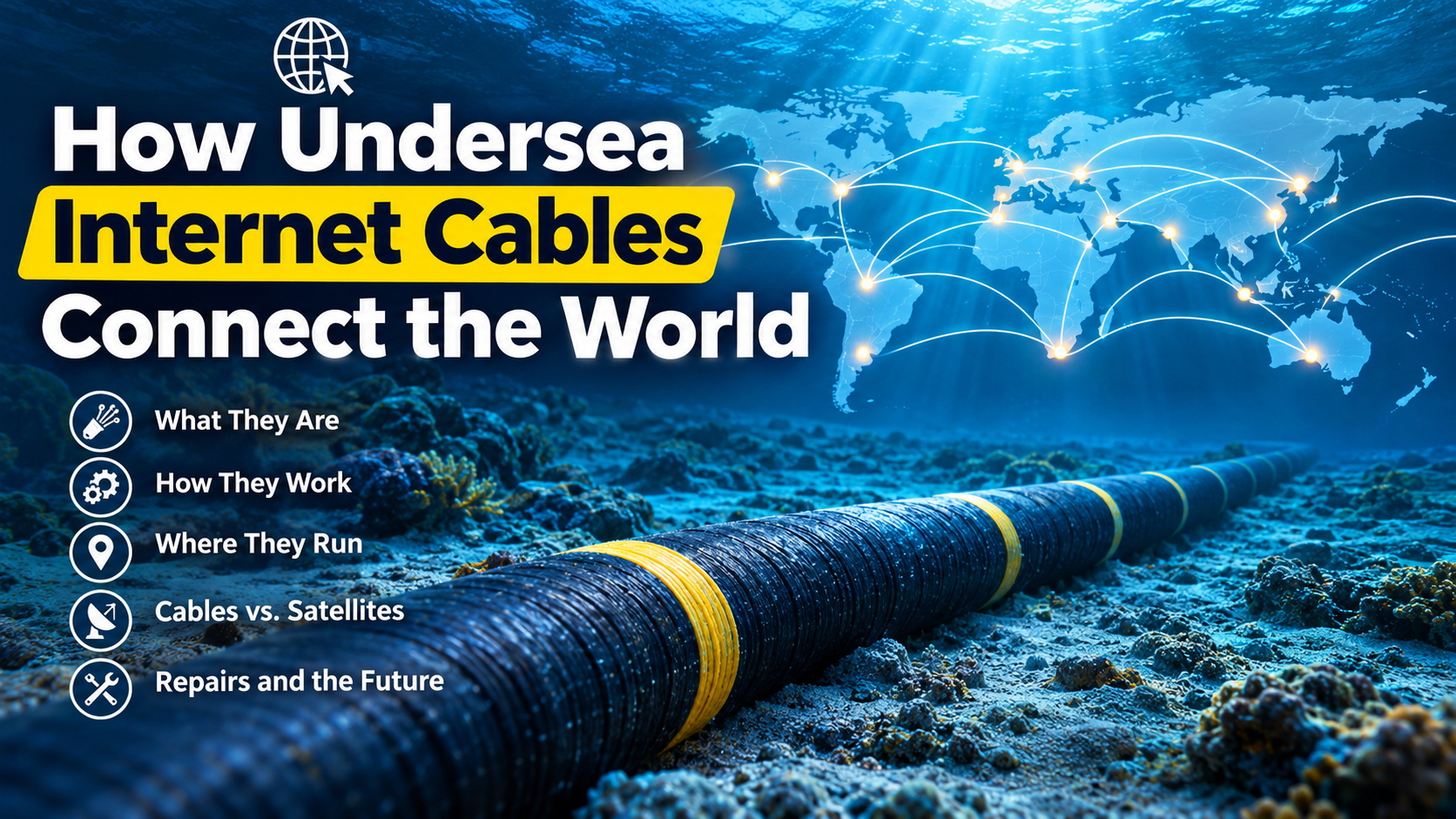

How Undersea Internet Cables Connect the World
Deep beneath the world’s oceans lies a vast network of fiber-optic cables that makes modern global communication possible. Every international video call, online transaction, and visit to a foreign website may depend on this remarkable infrastructure.
Although satellites often receive attention, undersea communication cables carry the overwhelming majority of intercontinental internet traffic. These cables connect countries, continents, data centers, financial markets, and billions of internet users.

What Are Undersea Internet Cables?
Undersea internet cables, also known as submarine communications cables, are specialized cables installed across the ocean floor to transmit digital information between distant locations.
Inside these cables are extremely thin strands of glass called optical fibers. Instead of using electricity to carry information through the fibers, modern submarine systems transmit data using pulses of light.
These optical fibers are protected by multiple layers of materials designed to withstand demanding marine conditions. Depending on the cable’s location, protection can include steel wires, insulation, waterproofing, and other structural components.
Despite their extraordinary capacity, many deep-ocean cables are surprisingly thin, sometimes comparable in diameter to a garden hose. Near shorelines, cables may require heavier armor to protect against fishing equipment, anchors, and other hazards.
How Are Undersea Cables Constructed?
A submarine cable is carefully engineered to protect delicate optical fibers while allowing signals to travel over enormous distances.

Typical components include:
- Optical fibers: Thin glass strands that carry encoded light signals.
- Protective tubing: Helps shield the optical fibers from moisture and mechanical damage.
- Strength members: Metallic components that support the cable during installation and recovery.
- Electrical conductor: In many long-distance systems, this supplies power to submerged optical repeaters.
- Outer insulation and armor: Provides additional environmental and physical protection.
The exact design varies depending on water depth, expected hazards, and the cable system’s technical requirements.
How Do Undersea Internet Cables Work?
Submarine cables use advanced optical communication systems to send enormous quantities of data between continents.
1. Converting Information into Signals
When you open a website or send a message, network equipment converts the information into digital signals. Optical transmission equipment then encodes the data onto light.
2. Sending Light Through Optical Fibers
Light travels through the optical fibers, carrying data across long underwater distances. Technologies such as wavelength-division multiplexing allow multiple channels of information to travel simultaneously through the same fiber.
3. Strengthening Signals Across Oceans
Over long distances, optical signals gradually weaken. Many transoceanic cables contain repeaters that amplify optical signals at regular intervals, helping information reach its destination reliably.
4. Reaching Cable Landing Stations
At coastal landing stations, submarine cable systems connect to land-based telecommunications infrastructure. From there, information travels through national and international networks to reach its destination.
5. Delivering Data to Users
The information eventually reaches the destination server, computer, or smartphone. This entire process can happen in fractions of a second, even when the data crosses an ocean.
Where Are the World’s Undersea Internet Cables?
Submarine cables stretch across the Atlantic, Pacific, and Indian Oceans, as well as numerous smaller seas and regional waterways.
Important international connections include:
- North America and Europe: Major transatlantic routes support enormous amounts of commercial, financial, and cloud computing traffic.
- Asia and North America: Transpacific cables provide essential communication capacity between major technology and economic centers.
- Europe, the Middle East, and Asia: Routes through the Mediterranean, Egypt, the Red Sea, and the Indian Ocean form important international connectivity corridors.
- Africa and Europe: Multiple cable systems connect African countries to global internet infrastructure.
- Australia and Asia: Submarine networks provide high-capacity connectivity across the Pacific and Indian Ocean regions.
According to TeleGeography, its global database recorded approximately 607 in-service submarine cable systems and 102 planned systems in 2026.
Explore the interactive global submarine cable map
How Are Undersea Cables Installed?
Installing a submarine cable is a complex engineering operation requiring detailed planning, marine surveys, and specialized equipment.
Before installation, engineers study the ocean floor to identify suitable routes and avoid major underwater hazards where possible.
Specialized cable-laying ships transport thousands of kilometers of cable in large storage tanks. During installation, the vessel carefully releases the cable along its planned route.

In deep water, cables are generally laid directly onto the seabed. In shallower areas, specialized equipment may bury them beneath the seabed to provide additional protection.
Once installed, the system undergoes extensive testing before becoming operational.
Why Are Undersea Cables Better for Global Traffic Than Satellites?
Satellites are extremely valuable for connecting remote areas, aircraft, vessels, and locations without terrestrial infrastructure. However, submarine cables remain the primary solution for high-capacity intercontinental data transmission.
| Feature | Undersea Cables | Satellites |
|---|---|---|
| Capacity | Extremely high | Generally lower per system |
| Latency | Low on major routes | Depends on orbital altitude |
| Cost per bit | Generally lower at scale | Generally higher |
| Coverage | Requires physical routes | Can serve remote regions |
Both technologies complement one another. Satellites improve coverage and flexibility, while fiber-optic networks supply the enormous capacity needed for international digital services.
What Happens When an Undersea Cable Breaks?
Submarine cables are built for long-term operation, but they remain vulnerable to damage.
Common causes of cable faults include:
- Fishing equipment and bottom trawling.
- Anchors dragged across the seabed.
- Underwater landslides and earthquakes.
- Mechanical problems or deterioration.
- Rare instances of deliberate interference.
When a cable is damaged, network operators often redirect traffic through alternative routes. If enough alternative capacity is available, users may notice little or no disruption.
However, isolated regions or countries with limited international connections may experience serious service interruptions.
Specialist repair vessels locate the affected section, recover the cable where possible, replace damaged components, test the repaired connection, and return the cable to the seabed.
Why Undersea Cables Matter to the Global Economy
Submarine telecommunications networks support many essential activities of modern society.
- International banking: Global financial institutions depend on reliable data connectivity.
- Cloud computing: Businesses exchange information between data centers in different regions.
- Video streaming: International content services use high-capacity networks to distribute digital media.
- Global business: Companies communicate and exchange information across international offices.
- Education and research: Universities and research institutions collaborate across continents.
- Artificial intelligence: Distributed computing systems and cloud services require increasingly powerful network connections.
Without dependable international fiber-optic infrastructure, many digital services would become slower, more expensive, or less reliable.
The Future of Submarine Internet Cables
Global demand for internet connectivity continues to increase as artificial intelligence, cloud computing, digital entertainment, and international data services expand.
To meet this demand, telecommunications companies are investing in new cable systems with improved optical technology, additional fiber pairs, and greater transmission capacity.
Governments and infrastructure operators are also focusing on network resilience. Building geographically diverse cable routes helps reduce dependence on individual connections and vulnerable maritime corridors.
Future systems will increasingly combine higher-capacity optical technologies with improved monitoring, network management, and security practices.
Conclusion
Undersea internet cables are among the most important technological systems in the modern world.
Hidden beneath the oceans, these remarkable fiber-optic networks connect continents and allow information to travel around the planet at extraordinary speeds.
From financial transactions to international video calls, much of everyday digital life depends on infrastructure that most people never see.
The internet may appear wireless, but the global digital world is largely connected by cables beneath the sea.