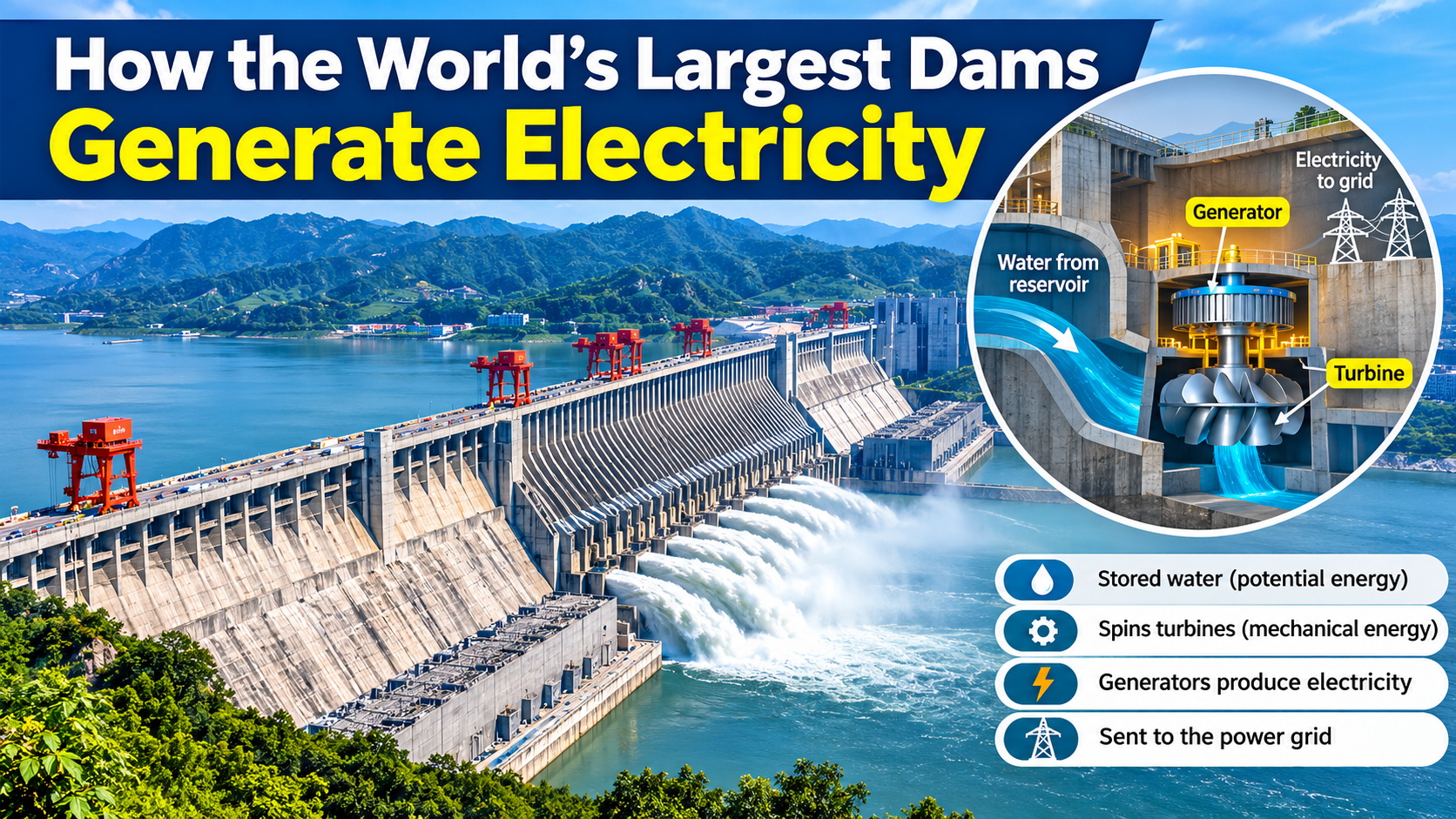

How the World’s Largest Dams Generate Electricity
The world’s largest hydroelectric dams are among the most impressive engineering achievements ever constructed. These enormous structures harness the natural energy of flowing water to produce electricity for homes, industries, and entire cities.
From China’s Three Gorges Dam to the Itaipu power station on the border of Brazil and Paraguay, hydroelectric facilities combine advanced civil engineering, powerful turbines, massive generators, and sophisticated electricity transmission systems.

How Does a Hydroelectric Dam Generate Electricity?
Hydroelectric power generation relies on a simple physical principle: water stored at a higher elevation contains gravitational potential energy. When released, the water flows downward, and its energy can be converted into mechanical motion and then electrical energy.
1. Water Is Stored in a Reservoir
A dam creates a reservoir by controlling the flow of a river. The stored water provides a source of gravitational potential energy. The elevation difference between the reservoir and the downstream water level is an important factor in determining available power.
2. Water Enters the Penstocks
Controlled intake gates direct water through large pipes or tunnels called penstocks. Gravity and pressure cause water to travel toward the turbines.
3. Water Spins the Turbines
Moving water passes through hydraulic turbines, causing their runners and connected shafts to rotate. Depending on the available hydraulic head and flow, hydropower stations may use Francis, Kaplan, or Pelton turbines.
4. Generators Produce Electricity
The rotating turbine drives an electrical generator. Inside the generator, a rotating magnetic field induces electrical voltage in stationary windings, converting mechanical energy into electricity.
5. Electricity Enters the Grid
Transformers increase the voltage of the generated electricity so it can travel efficiently through high-voltage transmission lines. Substations later reduce voltage for distribution to consumers.
6. Water Returns to the River
After passing through the turbines, water exits through the tailrace and continues downstream. The process uses the energy of moving water without consuming the water itself.
Inside the World’s Largest Hydroelectric Dams
Three Gorges Dam — China
Located on the Yangtze River, the Three Gorges Dam has an installed generating capacity of 22,500 megawatts (22.5 GW). It is the largest conventional hydroelectric power station in the world by installed capacity.
The facility uses dozens of large turbine-generator units to transform the energy of river water into electricity. Its output is delivered into China’s extensive power transmission network.

Beyond electricity generation, Three Gorges also plays roles in river navigation, water management, and flood control. However, its construction and operation have also caused significant environmental and social changes.
Baihetan Dam — China
The Baihetan hydropower station is located on the Jinsha River in southwestern China. With 16,000 MW of installed capacity, it ranks among the world’s largest hydroelectric facilities.
Baihetan uses 16 turbine-generator units, each rated at 1,000 MW. Its high-capacity equipment and underground powerhouses demonstrate the technical complexity of modern hydroelectric engineering.
The facility uses the elevation difference and controlled flow of the Jinsha River to drive massive turbine generators, producing electricity for China’s power grid.
Itaipu Dam — Brazil and Paraguay
Itaipu is a major binational hydroelectric power station on the Paraná River, jointly operated by Brazil and Paraguay.
It has an installed generating capacity of 14,000 MW, provided by 20 generating units rated at 700 MW each.

Itaipu demonstrates why installed capacity and actual electricity production are different. Its substantial river flow has enabled the facility to achieve exceptionally high annual electricity generation in favorable years.
Xiluodu Dam — China
The Xiluodu hydropower station, also located on the Jinsha River, has an installed capacity of 13,860 MW.
Its enormous concrete arch dam holds back water that powers turbine-generator equipment housed in underground facilities. Xiluodu is an important part of China’s large-scale hydroelectric infrastructure.
Comparing the World’s Largest Hydropower Stations
| Hydropower Station | Country | Installed Capacity |
|---|---|---|
| Three Gorges | China | 22,500 MW |
| Baihetan | China | 16,000 MW |
| Itaipu | Brazil / Paraguay | 14,000 MW |
| Xiluodu | China | 13,860 MW |
Comparison based on installed generating capacity, not physical dam size or annual electricity output.
What Determines How Much Electricity a Dam Produces?
A hydroelectric station’s power output mainly depends on three factors:
- Water flow: More water passing through the turbines generally allows more power generation.
- Hydraulic head: A greater elevation difference makes more energy available per unit of water.
- Efficiency: Turbine, generator, and hydraulic losses affect the electricity delivered by the plant.
Engineers estimate hydraulic power using the following equation:
P = η × ρ × g × Q × H
Here, P is electrical power, η is overall efficiency, ρ is water density, g is gravitational acceleration, Q is water flow rate, and H is net hydraulic head.
For example, a plant with a flow of 500 cubic metres per second, a net head of 100 metres, and an overall efficiency of 90% could produce approximately 441 MW, assuming sufficient generating equipment is available.
The Importance of Spillways
Not all water passing a dam is used to generate electricity. Spillways safely release excess water, particularly when reservoir levels rise during periods of heavy rainfall or flooding.

Spillways are essential for dam safety and water management, but water released through a conventional spillway normally bypasses the power-generating turbines.
Advantages of Hydroelectric Power
- Renewable energy: Hydropower uses water flows replenished through the natural water cycle.
- Low operational emissions: Generating electricity does not require burning fossil fuels, although reservoirs and construction can produce environmental impacts and emissions.
- Flexible generation: Many hydroelectric plants can adjust output relatively quickly.
- Long operating life: Properly maintained facilities can operate for many decades.
- Additional benefits: Some projects support flood control, navigation, or water management.
Environmental and Engineering Challenges
Despite their advantages, large hydroelectric dams can create substantial environmental and social challenges.
Reservoir construction may flood habitats, displace communities, and alter river ecosystems. Dams can restrict fish migration and interrupt the natural transport of sediment downstream.
Changing rainfall patterns and extended droughts can also reduce electricity generation. Operators must balance energy production with reservoir safety, environmental requirements, and downstream water needs.
The Future of Hydroelectric Technology
Modern hydropower facilities increasingly employ digital monitoring, automated control systems, advanced turbine designs, and predictive maintenance.
Pumped-storage hydropower is another important technology. It uses electricity to pump water to a higher reservoir when power is plentiful, then releases the stored water through turbines when electricity is needed.
Although pumped storage consumes more electricity than it returns, it can help balance power grids that include variable solar and wind generation.
Conclusion
The world’s largest hydroelectric dams demonstrate how gravity, water flow, and advanced engineering can generate enormous quantities of electricity.
From the 22,500 MW Three Gorges project to the massive generating units of Baihetan and the productive Itaipu facility, these power stations show how renewable energy can operate on a national scale.
Their future success will depend on efficient technology, responsible reservoir management, environmental protection, and the continuing modernization of electricity grids.