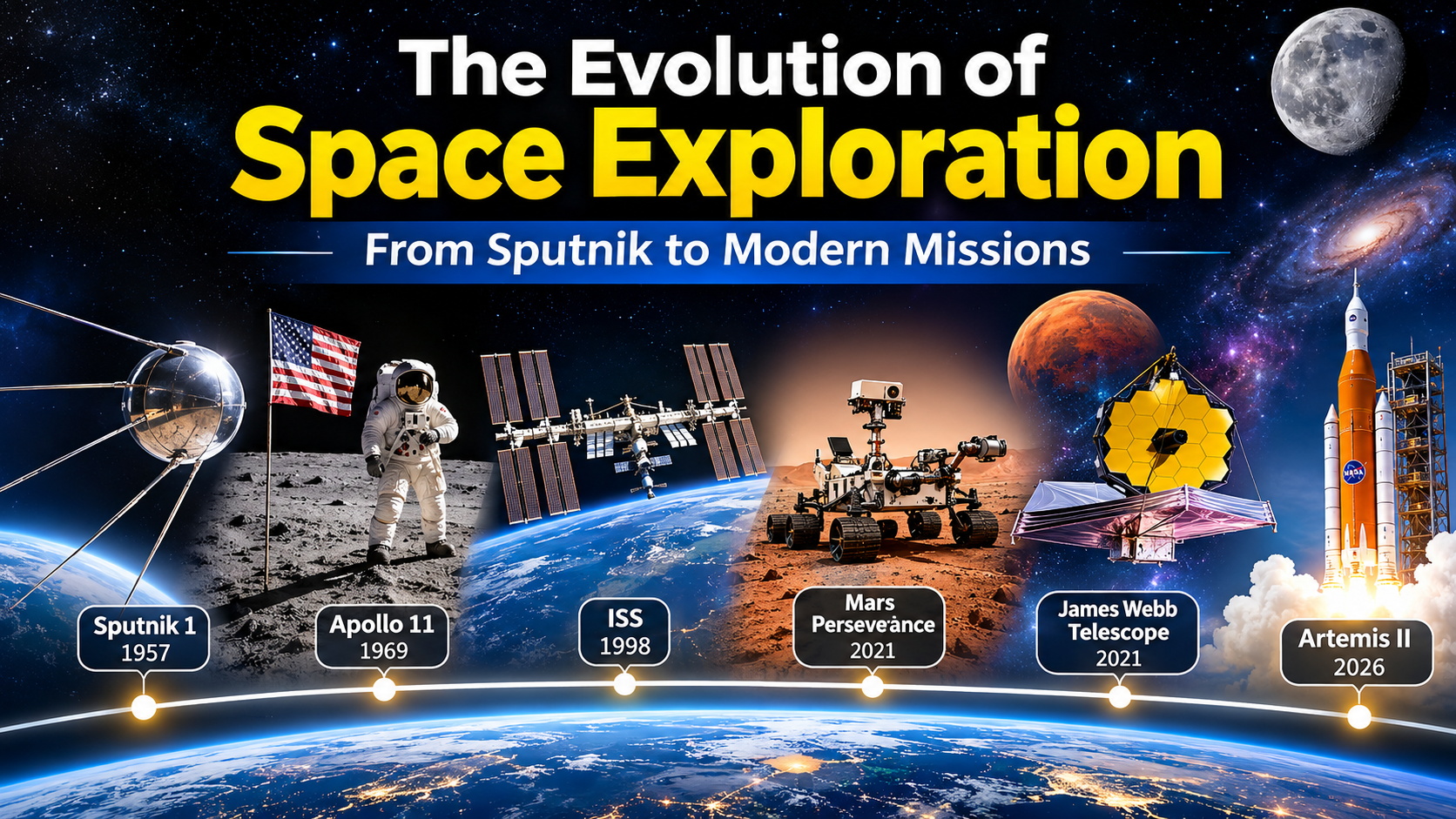

The Evolution of Space Exploration: From Sputnik to Modern Missions
Updated: November 2026 | Science & Technology
Space exploration has transformed humanity’s understanding of the universe. In less than seven decades, we have progressed from launching the first artificial satellite to landing humans on the Moon, exploring Mars with robotic vehicles, and building sophisticated observatories that study distant galaxies.
What began as a competition between superpowers has evolved into an international scientific effort involving government agencies, researchers, and private companies.
Discover the most important milestones that shaped the history of space exploration and the missions defining its future.
1. Sputnik 1: The Beginning of the Space Age (1957)

On October 4, 1957, the Soviet Union launched Sputnik 1, the world’s first artificial satellite, into Earth orbit.
The satellite weighed approximately 83.6 kilograms and measured 58 centimeters in diameter. It transmitted radio signals that scientists and amateur radio operators could detect from Earth.
Sputnik completed an orbit in approximately 98 minutes, proving that human-made objects could successfully circle our planet.
Its launch triggered the Space Race between the Soviet Union and the United States, accelerating developments in rocketry, satellites, electronics, and space science.
In 1958, the United States successfully launched Explorer 1 and established NASA.
2. The First Humans in Space (1961–1965)
On April 12, 1961, Soviet cosmonaut Yuri Gagarin became the first human to travel into space aboard Vostok 1.
His flight lasted approximately 108 minutes and included one orbit around Earth.
This historic achievement demonstrated that humans could survive spaceflight and return safely to Earth.
Other important milestones followed:
- 1963: Valentina Tereshkova became the first woman in space.
- 1965: Alexei Leonov completed the first spacewalk.
- 1965–1966: NASA’s Gemini missions developed orbital rendezvous, docking, and other techniques needed for lunar exploration.
These early missions provided critical knowledge about human physiology, spacecraft operations, and the challenges of working beyond Earth’s atmosphere.
3. Apollo 11: Humanity Reaches the Moon (1969)

On July 20, 1969, NASA’s Apollo 11 mission achieved one of humanity’s greatest technological accomplishments.
Neil Armstrong and Buzz Aldrin became the first humans to walk on the Moon, while Michael Collins remained aboard the command module in lunar orbit.
Apollo 11 demonstrated that astronauts could travel to another celestial body, conduct scientific research, and return safely to Earth.
Between 1969 and 1972, six Apollo missions successfully landed astronauts on the lunar surface.
The missions collected lunar samples that continue to help scientists understand the Moon’s formation and geological history.
4. Space Stations and the Shuttle Era (1971–2011)
After the first lunar landings, space agencies increasingly focused on long-duration missions and scientific research in Earth orbit.
The Soviet Union launched Salyut 1 in 1971, the world’s first space station. The later Mir station supported extensive research into long-duration spaceflight.
In 1981, NASA introduced the Space Shuttle, a partially reusable spacecraft system that supported satellite deployment, scientific experiments, and space station assembly.
Construction of the International Space Station (ISS) began in 1998, and the station has hosted a continuous human presence since November 2000.
The ISS became an important symbol of international cooperation. Astronauts aboard the station study human health, materials, plant growth, and the effects of microgravity.
5. Robotic Exploration: Mars and the Outer Planets

Robotic spacecraft have allowed scientists to explore destinations far beyond the reach of human astronauts.
NASA’s Viking missions successfully landed on Mars in 1976, providing important scientific data about the planet’s surface and atmosphere.
Voyager 1 and Voyager 2, launched in 1977, explored the outer planets. Both spacecraft later crossed into interstellar space.
In 2015, New Horizons completed the first close flyby of Pluto, revealing mountains, icy plains, and complex geological features.
Mars exploration has also advanced through robotic vehicles such as Sojourner, Spirit, Opportunity, Curiosity, and Perseverance.
Perseverance landed in Jezero Crater in February 2021. Its mission includes investigating ancient environments, studying Martian geology, and collecting rock samples that may help scientists search for evidence of ancient microbial life.
6. Space Telescopes and the James Webb Revolution

Space telescopes have transformed astronomy by observing the universe from beyond much of Earth’s atmosphere.
The Hubble Space Telescope, launched in 1990, revealed distant galaxies, star-forming regions, and other extraordinary cosmic phenomena.
The James Webb Space Telescope, launched on December 25, 2021, expanded these capabilities with powerful infrared instruments.
Webb studies early galaxies, stellar formation, planetary systems, and the atmospheres of certain planets beyond our Solar System.
These observations are helping scientists investigate how galaxies formed and evolved, as well as the conditions that may exist on distant worlds.
7. Reusable Rockets and Commercial Spaceflight
One of the most significant developments in modern space exploration is the growing role of commercial companies.
Historically, most orbital rockets were designed for a single use, making launches extremely expensive.
SpaceX demonstrated a major advance in December 2015 when a Falcon 9 first-stage booster landed successfully after an orbital launch.
In March 2017, SpaceX successfully launched a previously flown Falcon 9 orbital-class booster again.
Reusable rocket technology has helped make launches more frequent and potentially less expensive, although the economics depend on the vehicle and mission.
Companies such as Blue Origin and Rocket Lab are also developing launch systems and technologies that may expand commercial access to space.
8. Artemis: Humanity Returns to Lunar Exploration
NASA’s Artemis program represents a major new chapter in human space exploration.
The program aims to support a sustained return to the Moon, enable important scientific research, and develop technologies that could eventually support missions to Mars.
On April 1, 2026, Artemis II launched four astronauts aboard NASA’s Orion spacecraft.
The crew consisted of Reid Wiseman, Victor Glover, Christina Koch, and Canadian astronaut Jeremy Hansen.
After traveling around the Moon, the astronauts safely returned to Earth on April 10, 2026.
Artemis II was the first crewed mission to travel to the vicinity of the Moon since Apollo 17 in 1972.
Other nations are also pursuing lunar exploration. China’s Chang’e-6 mission returned the first samples from the Moon’s far side in 2024.
Future lunar missions could help scientists investigate water ice, lunar geology, and technologies necessary for longer-duration human exploration.
Explore NASA’s official Artemis II mission page.
9. Searching for Life Beyond Earth
One of the most important questions in modern space science is whether life exists elsewhere in the universe.
Scientists are studying environments that may contain liquid water, organic chemistry, and potential energy sources.
NASA’s Europa Clipper spacecraft launched in October 2024 and is scheduled to arrive at Jupiter in 2030.
The spacecraft will investigate Europa, an icy moon believed to contain a global ocean beneath its frozen surface.
Europa Clipper will assess whether the moon has conditions suitable for life, rather than attempting to detect living organisms directly.
Other research targets include Saturn’s moon Titan, ancient environments on Mars, and distant exoplanets orbiting other stars.
10. Major Milestones in Space Exploration
| Year | Milestone |
|---|---|
| 1957 | Sputnik 1 becomes the first artificial satellite |
| 1961 | Yuri Gagarin becomes the first human in space |
| 1963 | Valentina Tereshkova becomes the first woman in space |
| 1969 | Apollo 11 achieves the first crewed Moon landing |
| 1971 | Salyut 1 becomes the first space station |
| 1977 | Voyager 1 and Voyager 2 launch |
| 1981 | First Space Shuttle flight |
| 1990 | Hubble Space Telescope launches |
| 1998 | ISS assembly begins |
| 2015 | New Horizons flies past Pluto |
| 2021 | James Webb Space Telescope launches |
| 2024 | Chang’e-6 returns far-side lunar samples |
| 2026 | Artemis II completes a crewed lunar flyby |
11. The Future of Space Exploration
The next generation of missions could transform humanity’s relationship with space.
Possible developments include longer-duration lunar habitats, advanced robotic exploration, improved spacecraft propulsion, and technologies that could support human journeys to Mars.
Artificial intelligence and autonomous systems may allow spacecraft to navigate, analyze scientific observations, and make certain decisions with less immediate assistance from Earth.
Important challenges remain, including radiation exposure, long-duration astronaut health, launch costs, space debris, and the sustainability of space activities.
International cooperation, responsible use of orbital environments, and continued scientific research will be essential to the future of exploration.
Conclusion: A Journey That Has Only Begun
From Sputnik 1 to the Artemis program, the history of space exploration demonstrates the remarkable progress that scientific curiosity and technological innovation can achieve.
Humans have walked on the Moon, robotic explorers have traveled across Mars, and telescopes have revealed galaxies billions of light-years away.
Although the next major discoveries remain uncertain, one thing is clear: humanity’s exploration of the universe is far from complete.
The next chapter of space exploration may change not only what we know about the universe, but also how we understand our place within it.
Sources and Further Reading
- NASA – Sputnik 1
- NASA – Apollo 11 Photography
- NASA JPL – Perseverance Rover
- NASA – James Webb Space Telescope
- NASA – Artemis II
- NASA – Europa Clipper
Image credits belong to the respective NASA agencies and contributors. Review NASA’s media usage guidelines before commercial publication. An external image link does not guarantee permanent hosting availability.