
BIN3AIAH | SCIENCE & TECHNOLOGY
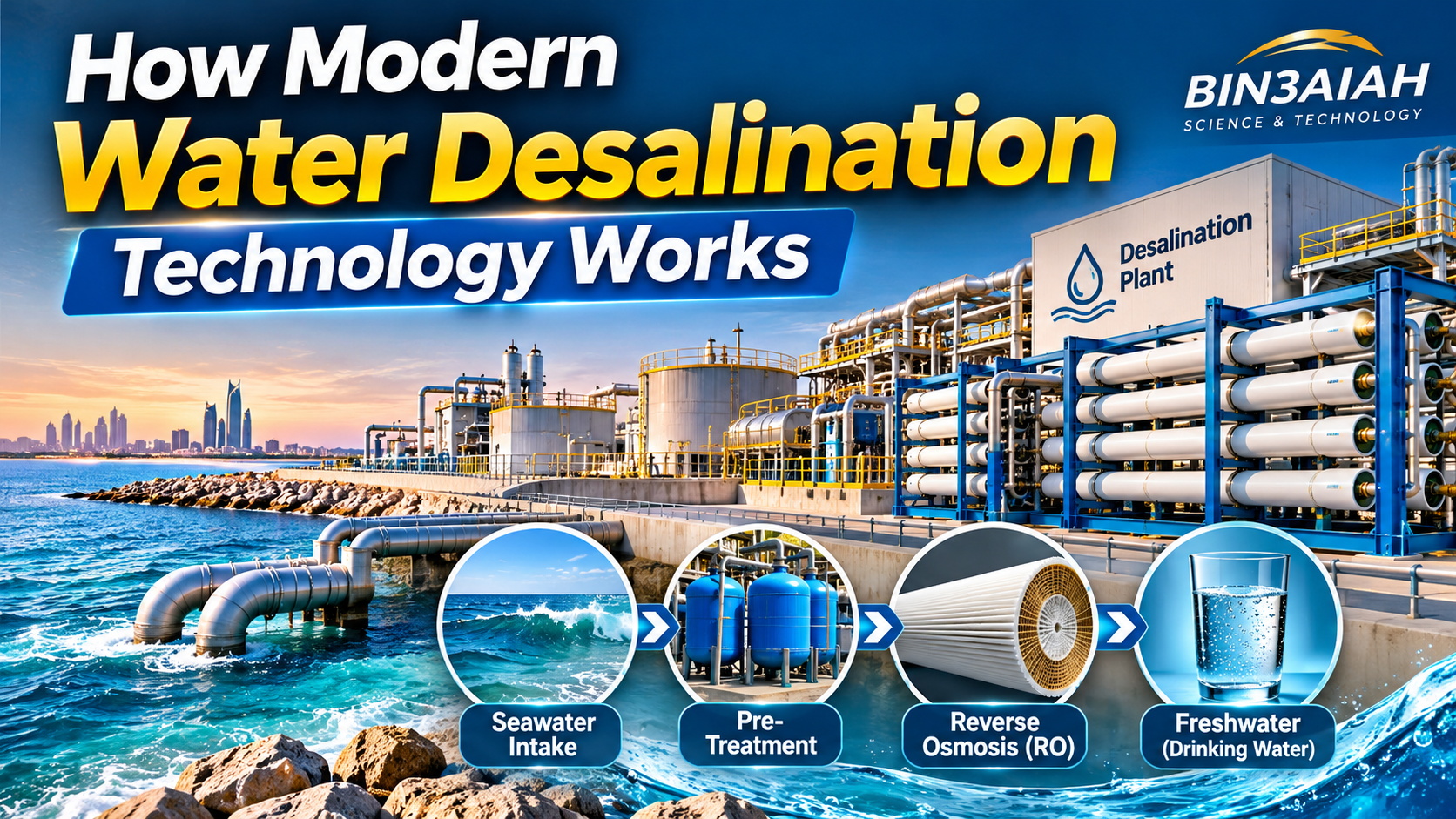
How Modern Water Desalination Technology Works
The extraordinary engineering behind transforming seawater into freshwater.
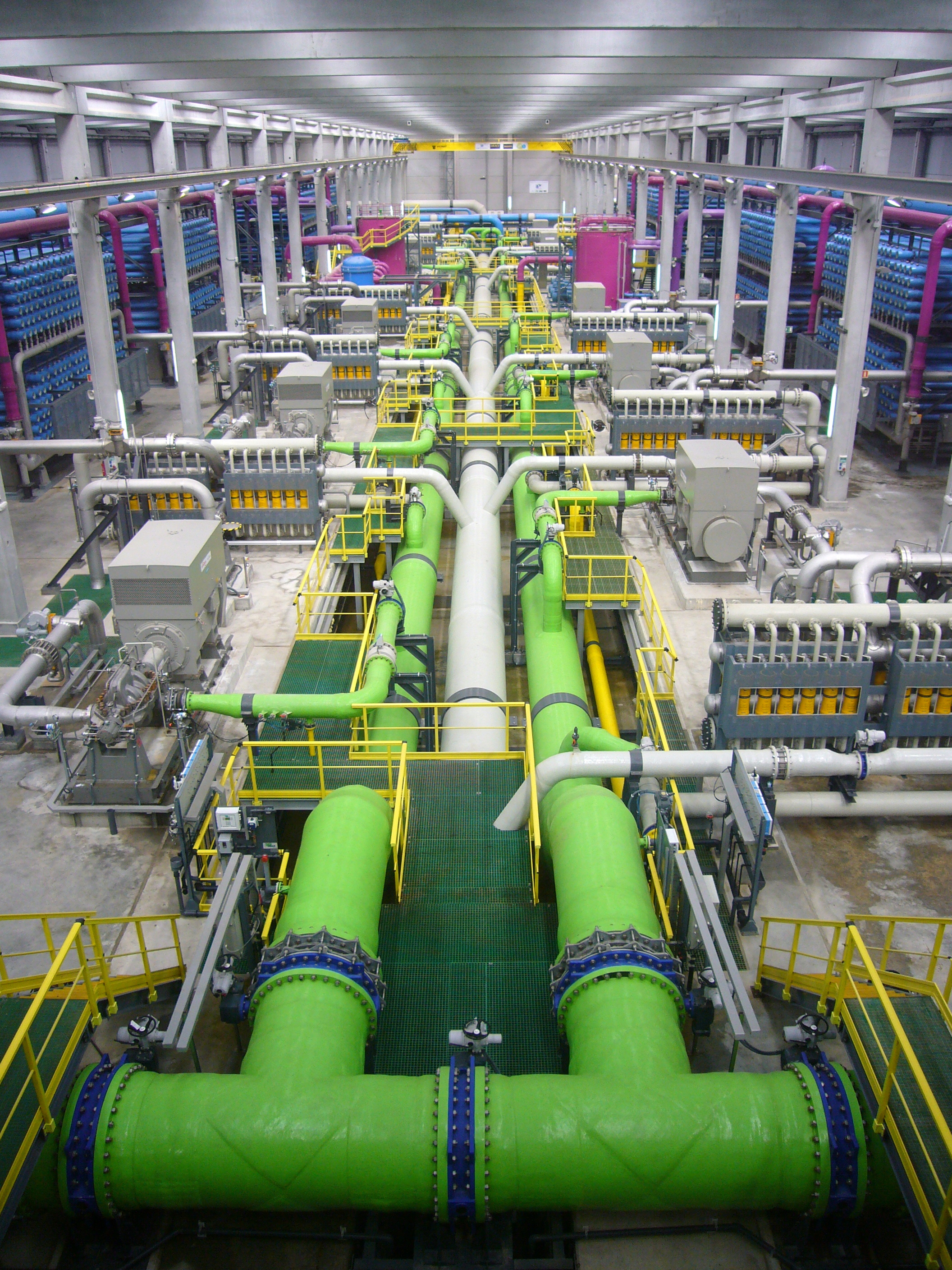
Water is essential for human survival, economic development and environmental sustainability. However, approximately 97% of Earth’s water is contained in the oceans, making it unsuitable for direct human consumption.
Modern water desalination technology provides an innovative solution to freshwater scarcity by removing dissolved salts, minerals and contaminants from seawater and brackish water.
From the coastal cities of the United Arab Emirates to communities across the Mediterranean, Australia and California, desalination has become an important component of modern water infrastructure.
Modern Desalination at a Glance
Typical electricity per cubic metre of freshwater
Typical high-performance membrane salt rejection
Typical seawater RO pressure in bar
Illustrative freshwater recovery rate
Performance varies according to water salinity, temperature, equipment and plant design.
1. What Is Water Desalination?
Water desalination is the process of separating dissolved salts and other impurities from saline water to produce freshwater suitable for drinking, industrial operations and other applications.
Ordinary water filters cannot effectively remove dissolved salt. Desalination requires specialized membranes, thermal separation or other advanced technologies.
The three major commercial seawater desalination technologies are:
- Reverse Osmosis (RO): Uses pressure and semi-permeable membranes to separate water from dissolved salts.
- Multi-Stage Flash Distillation (MSF): Uses heated seawater and progressively lower pressures to generate freshwater vapour.
- Multi-Effect Distillation (MED): Reuses thermal energy across multiple evaporation stages.
Reverse osmosis has become the preferred technology for many new desalination projects because of its relatively low energy requirements and modular design.
2. How Reverse Osmosis Works

Osmosis is a natural process in which water moves through a semi-permeable membrane toward a solution containing a higher concentration of dissolved substances.
Reverse osmosis reverses this natural movement by applying external pressure greater than the osmotic pressure.
Under high pressure, water passes through a specialized membrane while most dissolved salts remain on the concentrated side.
Understanding the Diagram
A: Applied pressure
B: Incoming seawater
C: Dissolved contaminants
D: Semi-permeable membrane
E: Purified water
F: Water outlet
The process produces two separate streams:
- Permeate: Purified water that passes through the membrane.
- Concentrate or brine: Water containing the rejected salts and minerals.
3. The Six Stages of Modern Water Desalination
Post-Treatment
Energy Recovery and Management
Stage 1: Seawater Intake
Seawater enters the desalination facility through offshore pipelines, coastal wells or specially designed intake structures. Screens prevent large debris and marine organisms from entering the treatment equipment.
Stage 2: Pre-Treatment
Incoming seawater undergoes filtration to remove suspended particles, sediment, algae and microorganisms. Depending on the facility, treatment may involve multimedia filters, ultrafiltration membranes and chemical conditioning.
This stage protects the reverse osmosis membranes against contamination, scaling and premature deterioration.
Stage 3: High-Pressure Pumping
Industrial pumps increase seawater pressure, typically to approximately 55–80 bar. The required pressure depends on the salt concentration, water temperature and membrane characteristics.
Stage 4: Membrane Separation

The pressurized seawater enters membrane modules containing specialized polymer layers. These membranes allow water to pass through while rejecting most dissolved salts.
Modern membrane elements are commonly arranged in spiral-wound configurations, providing a large filtration surface within a compact cylindrical module.
Stage 5: Post-Treatment
Freshly desalinated water contains very low concentrations of dissolved minerals. Before entering drinking-water networks, it normally undergoes remineralization, pH adjustment and disinfection.
These processes improve taste, chemical stability and compatibility with distribution pipelines.
Stage 6: Storage and Distribution
The treated freshwater is stored in reservoirs before being delivered through pumping stations and distribution networks to residential, commercial and industrial consumers.
4. Thermal Desalination Technologies

Before reverse osmosis became widely adopted, many large desalination facilities relied on thermal technologies.
Multi-Stage Flash Distillation (MSF)
MSF heats seawater before passing it through a series of chambers maintained at progressively lower pressures.
As the pressure decreases, a portion of the seawater rapidly evaporates. The resulting vapour is condensed into freshwater, leaving most dissolved salts behind.
Multi-Effect Distillation (MED)
MED uses multiple evaporation chambers, known as effects. Vapour generated in one effect provides heat for the following effect, allowing thermal energy to be reused repeatedly.
This method improves heat utilization compared with simple single-stage distillation and can be attractive where suitable waste heat is available.
5. Desalination Technology Comparison
| Feature | RO | MSF | MED |
|---|---|---|---|
| Operating principle | Membranes | Flash evaporation | Multi-effect evaporation |
| Primary energy | Electricity | Heat and electricity | Heat and electricity |
| Operating temperature | Relatively low | High | Moderate |
| Modular expansion | Excellent | Limited | Moderate |
| Solar electricity integration | Straightforward | More complex | More complex |
| Main challenge | Membrane fouling | Thermal energy demand | Scaling and heat supply |
Reverse osmosis generally requires less energy than conventional thermal desalination, although the overall comparison depends on the availability and source of thermal energy.
6. Energy Recovery: Making Desalination More Efficient
One of the most significant advances in desalination engineering is the development of energy recovery devices.
After passing through reverse osmosis modules, concentrated brine retains substantial hydraulic pressure. Instead of allowing this energy to be wasted, modern pressure exchangers transfer much of it to incoming seawater.
Why Energy Recovery Matters
- Reduces electricity consumption.
- Lowers the workload of high-pressure pumps.
- Decreases freshwater production costs.
- Improves overall plant efficiency.
- Can reduce greenhouse gas emissions.
Modern seawater reverse osmosis facilities can typically produce one cubic metre of freshwater using approximately 3–4 kilowatt-hours of electricity, although actual energy consumption varies between facilities.
7. How Much Freshwater Can Be Produced?
Freshwater recovery represents the percentage of incoming seawater converted into purified water. Modern seawater reverse osmosis facilities frequently operate at recovery rates around 40–50%, depending on local conditions.
Example: 1,000 Litres of Seawater
Assuming a freshwater recovery rate of 45%.
Freshwater
Concentrated Brine
Estimated electricity: 1.35–1.80 kWh for the freshwater produced, assuming 3–4 kWh per cubic metre.
8. Water Desalination in the United Arab Emirates

The United Arab Emirates has developed extensive desalination infrastructure to meet growing demand for freshwater in one of the world’s driest regions.
Historically, many UAE facilities combined thermal desalination with electricity generation. More recent investments have increasingly focused on energy-efficient reverse osmosis technology.
Taweelah Reverse Osmosis Desalination Plant
Located in Abu Dhabi, the Taweelah facility demonstrates the extraordinary scale of modern membrane-based water production. The project reached commercial operation in 2024.
TAWEELAH RO | ABU DHABI
909.2 Million
Litres of freshwater per day
Designed production capacity of approximately 909,200 cubic metres daily.
The plant highlights how large-scale reverse osmosis can strengthen national water security while reducing reliance on conventional thermal desalination.
Other important UAE desalination developments include Jebel Ali, Hassyan and facilities serving the Northern Emirates.
Learn more from the official Taweelah RO project information.
9. Environmental Advantages and Challenges
Although desalination provides significant benefits, it also presents environmental and economic challenges that require responsible engineering and management.
Advantages
- Reliable freshwater supply.
- Reduced dependence on rainfall.
- Improved national water security.
- High-quality treated water.
- Compatibility with renewable electricity.
- Support for urban and industrial growth.
Challenges
- Concentrated brine discharge.
- Electricity and heat requirements.
- High initial infrastructure costs.
- Membrane replacement and maintenance.
- Potential marine ecosystem impacts.
- Chemical treatment requirements.
The Challenge of Brine Disposal
Desalination produces concentrated saltwater that may contain residual treatment chemicals. Poorly managed discharge can increase local salinity and affect sensitive marine habitats.
Modern facilities use environmental monitoring, engineered discharge diffusers and other management techniques to reduce these impacts.
Researchers are also investigating methods to recover useful minerals from brine instead of treating it solely as a waste product.
10. The Future of Water Desalination Technology
Future desalination systems are expected to become more energy-efficient, automated and environmentally responsible.
Solar-Powered Desalination
Renewable electricity can power reverse osmosis equipment and reduce dependence on fossil fuels.
Advanced Membranes
New polymer materials, nanotechnology and graphene-based membrane research could improve filtration and reduce energy demand.
Artificial Intelligence
Intelligent monitoring systems can help optimize operating pressure, detect faults and predict maintenance requirements.
Brine Mineral Recovery
Emerging separation technologies may enable the recovery of commercially valuable minerals from concentrated seawater.
Zero Liquid Discharge
Advanced treatment processes aim to recover additional water and convert remaining dissolved salts into solids, although costs and energy requirements remain significant.
Hybrid Desalination
Combining membrane, thermal and other separation technologies may improve resource utilization under suitable operating conditions.
11. Frequently Asked Questions
Is desalinated water safe to drink?
Yes. Properly treated, remineralized, disinfected and monitored desalinated water can meet applicable drinking-water quality standards.
What is the most common modern desalination technology?
Reverse osmosis is the dominant technology for new seawater desalination installations because of its efficiency and modular design.
Can desalination operate using solar energy?
Yes. Solar photovoltaic systems can generate electricity for reverse osmosis facilities. Solar thermal energy can also support certain desalination processes.
Why does desalination require so much energy?
Separating dissolved salts from water requires energy. Reverse osmosis uses pressure to overcome osmotic pressure, while thermal methods require heat to evaporate water.
Why is desalination important in the UAE?
The UAE has limited rainfall and natural freshwater resources. Desalination provides a dependable water supply for its population and economy.
Can desalination solve global water scarcity?
Desalination can substantially improve water security in coastal regions, but it must be combined with water conservation, wastewater recycling, responsible resource management and environmental protection.
Conclusion
Modern water desalination technology represents one of humanity’s most important achievements in environmental engineering.
By combining advanced membranes, high-pressure pumping, energy recovery and intelligent monitoring, desalination facilities transform seawater into a valuable freshwater resource.
As renewable energy, membrane science and sustainable brine management continue to advance, desalination has the potential to become an increasingly efficient and environmentally responsible solution.
The future of water security depends not only on producing more freshwater, but also on using it wisely and protecting the ecosystems that make life possible.
References and Further Reading
- U.S. Geological Survey – Desalination
- U.S. Geological Survey – Reverse Osmosis
- ACWA Power – Taweelah RO Desalination Project
- Dubai Electricity and Water Authority
- Wikimedia Commons – Desalination Facilities
BIN3AIAH
Explore Science, Engineering, Technology and Innovation.
Explore More Articles© 2026 Bin3aiah. Article rights reserved. Images retain their respective licences.