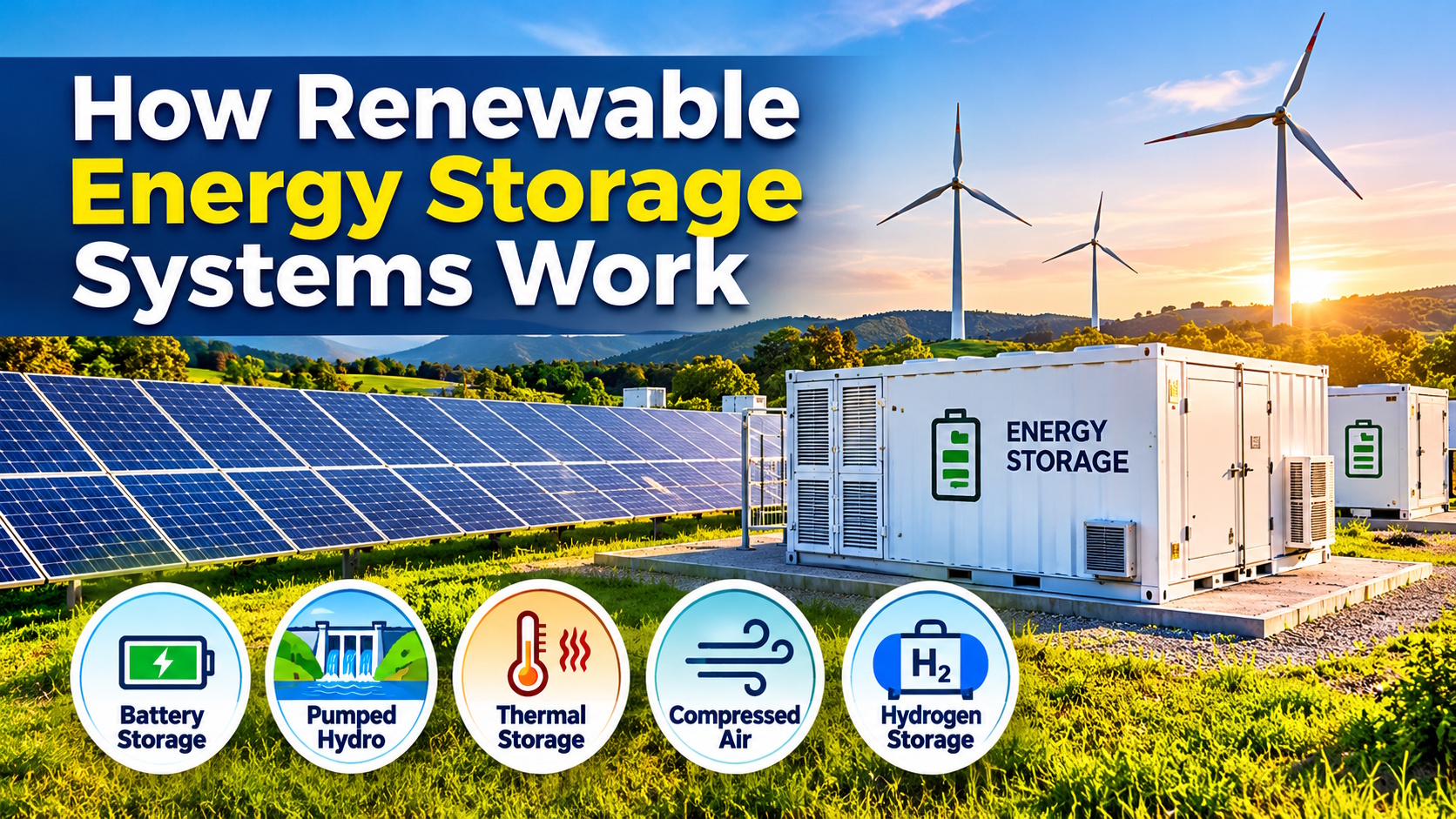

How Renewable Energy Storage Systems Work
Discover how batteries, pumped hydro, thermal storage, compressed air and hydrogen technology help make renewable electricity more reliable.

Introduction
Renewable energy is changing the way electricity is generated and consumed. Solar panels transform sunlight into electricity, wind turbines capture the energy of moving air, and hydropower systems harness the force of water.
However, renewable electricity generation is not always available when consumers need it most.
Solar panels produce no electricity from sunlight at night, while wind power varies according to weather conditions. Electricity demand also changes throughout the day.
Renewable energy storage systems help solve this challenge by capturing surplus electricity and making it available later.
From lithium-ion batteries to massive pumped hydroelectric facilities, energy storage technologies are becoming an important part of modern electricity infrastructure.
1. What Is Renewable Energy Storage?
An energy storage system (ESS) is equipment that captures energy, stores it in a suitable form, and releases it when required.
Stored energy may take several forms, including:
- Chemical energy inside rechargeable batteries
- Gravitational potential energy in elevated water
- Thermal energy stored as heat
- Mechanical energy in compressed air
- Chemical energy contained in hydrogen
The Four Main Operating Stages
- Generation: Solar panels, wind turbines or another source generate electricity.
- Charging: Available electricity is used to charge a storage system.
- Storage: The energy remains stored until required.
- Discharging: Stored energy is delivered as electricity or another useful form of energy.
How Energy Storage Works
☀️ Solar + 🌬️ Wind
↓
⚡ Electricity Generation
↓
🔋 Energy Storage
↓
🏠 Homes + 🏭 Industry + ⚡ Power Grid
2. Lithium-Ion Battery Energy Storage

Lithium-ion batteries are widely used for renewable electricity storage because they offer fast response times, relatively high efficiency, and modular construction.
These batteries are found in residential solar installations, commercial buildings, and large power-grid storage facilities.
How Lithium-Ion Batteries Work
When a battery charges, electrical energy drives lithium ions between two electrodes through an electrolyte.
During discharge, the electrochemical reaction reverses, causing electrons to travel through an external circuit and deliver electrical power.
A complete battery energy storage system typically contains:
- Rechargeable battery cells and modules
- Battery management system (BMS)
- Power conversion equipment
- Inverters and transformers
- Cooling and thermal control systems
- Fire protection and electrical safety systems
- Monitoring and energy management software
Advantages
- High energy efficiency
- Very fast charging and discharging response
- Suitable for residential and grid-scale applications
- Easy to expand using modular installations
- Useful for grid frequency regulation
Limitations
- Capacity gradually declines with aging and repeated use
- Requires appropriate thermal management
- Some battery chemistries depend on specialized materials
- Long-duration storage can require substantial investment
3. Pumped Hydroelectric Energy Storage

Pumped hydroelectric storage is a mature, large-scale energy storage technology.
It relies on gravity and two water reservoirs positioned at different elevations.
How Pumped Hydro Works
- Surplus electricity powers pumps.
- Water is transferred from a lower reservoir to an upper reservoir.
- The elevated water stores gravitational potential energy.
- When electricity demand rises, water flows downhill.
- The moving water drives turbines connected to generators.
The amount of energy stored depends mainly on the volume of water and the height difference between reservoirs.
Advantages
- Very large storage capacity
- Long operating life
- Can deliver electricity for extended periods
- Well-established engineering technology
Limitations
- Requires suitable geographical conditions
- High initial construction costs
- Environmental and water management considerations
- Long project development periods
4. Thermal Energy Storage

Thermal energy storage captures and retains energy in the form of heat or cold.
Storage materials may include molten salts, water, rocks, ceramics, and phase-change materials.
How Thermal Storage Works
- Solar collectors or electrical heaters provide thermal energy.
- A storage material absorbs the energy.
- The heated material is kept inside an insulated storage system.
- Stored heat is released when needed.
- Heat can supply industrial processes, buildings, or an electricity-generating system.
For example, concentrated solar power installations can store heat in molten salts and use it later to produce steam that operates an electricity-generating turbine.
Advantages
- Useful for industrial heating and cooling
- Can store large quantities of thermal energy
- Some technologies use inexpensive materials
- Can extend concentrated solar power operation beyond sunset
Limitations
- Heat losses occur over time
- Requires efficient insulation
- Converting thermal energy into electricity introduces losses
5. Compressed Air Energy Storage
Compressed air energy storage, or CAES, converts surplus electrical energy into the energy of pressurized air.
Compressed air can be retained in engineered tanks or suitable underground geological formations.
How It Works
- Excess electricity powers air compressors.
- Air is compressed to a higher pressure.
- The compressed air is stored.
- When energy is needed, the air is released and expanded through machinery.
- The expanding air drives a generator to produce electricity.
Some advanced designs recover and store heat generated during compression to improve efficiency.
Advantages
- Potential for large energy storage capacity
- Can provide electricity for extended periods
- Suitable for certain long-duration storage applications
Limitations
- Underground storage may require specific geology
- Energy is lost during compression and expansion
- Heat management affects system performance
6. Hydrogen Energy Storage
Hydrogen storage uses surplus electricity to produce a fuel that can be stored and used later.
When renewable electricity powers water electrolysis, the hydrogen produced is commonly called green hydrogen.
How Hydrogen Storage Works
- Renewable electricity powers an electrolyzer.
- The electrolyzer splits water into hydrogen and oxygen.
- Hydrogen is collected and stored.
- Stored hydrogen can be supplied to a fuel cell, turbine, or industrial process.
- Fuel cells can convert hydrogen back into electricity.
Hydrogen can potentially be stored for long periods, making it interesting for seasonal energy balancing and industrial decarbonization.
Advantages
- Potential for long-duration and seasonal storage
- Can support transportation and industrial applications
- Provides an alternative method of storing renewable energy
Limitations
- Lower electricity-to-electricity efficiency than batteries
- Specialized storage infrastructure is required
- Hydrogen production and conversion equipment can be expensive
- Requires appropriate handling and safety systems
7. Comparing Energy Storage Technologies
| Technology | Typical Duration | Approx. Efficiency | Best Application |
|---|---|---|---|
| Lithium-Ion | 1–8 hours | 85–95% | Short-term storage |
| Pumped Hydro | 6–24+ hours | 70–85% | Large-scale storage |
| Flow Batteries | 4–12+ hours | 65–85% | Extended discharge |
| Compressed Air | Hours to days | 40–70% | Long-duration storage |
| Hydrogen | Days to seasons | 25–45% | Seasonal storage |
Note: Values are approximate and depend on technology design and operating conditions. Efficiencies refer to electricity-to-electricity round trips. Thermal storage is excluded from the efficiency comparison because direct heat storage and electricity generation have different conversion boundaries.
8. How Solar Power and Batteries Work Together

Combining solar panels with battery storage allows renewable electricity generated during the day to be used later.
Morning and Afternoon
Solar panels produce electricity, supplying immediate consumption and potentially charging batteries with available surplus energy.
Evening
As sunlight decreases, batteries discharge to help supply electricity during periods of greater demand.
Night
Stored electricity continues supporting demand until the battery reaches its minimum permitted charge level.
Example: Battery Storage Capacity
Battery capacity: 10 MWh
Discharge power: 2 MW
Ideal operating duration: 5 hours
10 MWh ÷ 2 MW = 5 Hours
Actual runtime may be shorter because of electrical losses, operating limits, and reserved battery capacity.
Megawatts (MW) describe how quickly a storage system delivers power. Megawatt-hours (MWh) describe the total amount of energy stored.
9. Benefits of Renewable Energy Storage
Improved Electricity Reliability
Energy storage helps electrical systems balance changing generation and consumption.
Greater Renewable Energy Utilization
Storage allows surplus renewable electricity to be used later instead of being curtailed.
Peak Demand Management
Stored electricity can be delivered during periods of high demand, potentially reducing the need for additional peak-generation capacity.
Grid Stability
Fast-response storage systems can provide frequency regulation and other essential grid services.
Backup Electricity
Systems equipped with appropriate backup capability can support essential loads during power interruptions.
10. Challenges and Limitations
Despite their importance, renewable energy storage technologies must overcome several challenges.
- Cost: Large storage installations require significant investment.
- Efficiency: Energy is lost during charging, storage, or discharging.
- Materials: Some technologies depend on specialized supply chains.
- Safety: Batteries, compressed air, and hydrogen require engineering controls.
- Environmental impact: Manufacturing, construction, land use, and recycling must be considered.
- Duration: Different technologies are suited to different storage timescales.
11. Future Energy Storage Technologies

The future of renewable electricity storage will likely involve several technologies working together.
Important areas of innovation include:
- Sodium-ion batteries: An alternative battery chemistry using widely available sodium.
- Flow batteries: Rechargeable systems using liquid electrolytes and external storage tanks.
- Gravity storage: Storing energy by lifting heavy objects and recovering energy as they descend.
- Advanced thermal storage: Improved materials for efficient heat storage.
- Green hydrogen: Renewable hydrogen production for energy storage and industry.
- Smart energy management: Advanced software for coordinating generation, storage, and electricity demand.
As electricity networks integrate more renewable generation, energy storage will become increasingly important for providing flexibility and resilience.
Conclusion
Renewable energy storage systems are helping transform electricity production from a system dependent on immediate generation into one capable of retaining energy for future demand.
Lithium-ion batteries offer rapid response and efficient short-duration storage. Pumped hydro provides large-scale storage capacity. Thermal systems retain energy as heat, while compressed air and hydrogen offer additional options for longer storage periods.
Although no single technology is ideal for every application, combining different storage solutions can support more reliable and sustainable electricity networks.
The future of renewable energy depends not only on generating clean electricity, but also on storing it efficiently and delivering it when it is needed most.