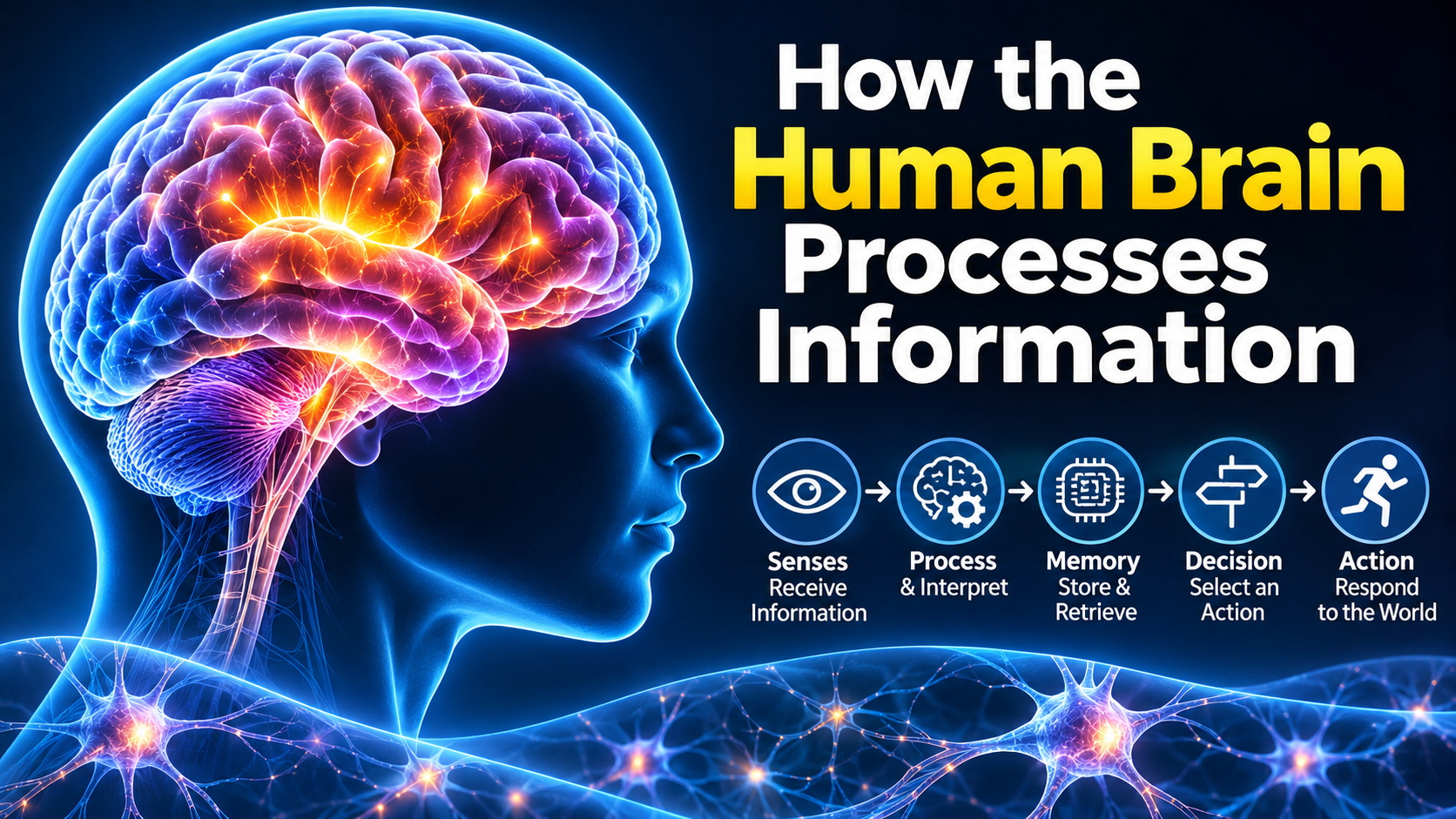

How the Human Brain Processes Information
The human brain is one of the most remarkable information-processing systems in nature. Every second, it receives sensory signals, interprets experiences, retrieves memories, makes decisions, and coordinates actions. These processes allow humans to recognize faces, understand language, learn new skills, solve problems, and respond to their surroundings.
Although the brain is sometimes compared to a computer, it operates very differently. Instead of relying on a single processor, it uses enormous networks of interconnected neurons that communicate through electrical and chemical signals.


1. How the Brain Receives Information
Information processing begins when sensory receptors detect changes in the environment or inside the body.
The five traditionally recognized senses—vision, hearing, touch, taste, and smell—provide essential information. The brain also processes balance, body position, temperature, pain, and signals from internal organs.
For example, when you look at a moving vehicle, light enters your eyes and stimulates photoreceptors in the retina. These specialized cells convert light into neural signals that travel through the optic nerves toward visual-processing regions of the brain.
The brain analyzes features such as movement, shape, color, and location. Information from other senses can then be integrated to build a coherent understanding of the surrounding world.
2. Neurons: The Brain’s Communication Network
The human brain contains approximately 86 billion neurons. These specialized nerve cells form complex networks that transmit and process information.
Most neurons have three principal structural components:
- Dendrites: Receive signals from other neurons.
- Cell body: Integrates incoming signals and maintains the cell.
- Axon: Carries electrical impulses toward other cells.


When a neuron becomes sufficiently excited, it can generate an electrical impulse called an action potential. This impulse travels along the axon.
At many connections between neurons, known as synapses, electrical activity triggers the release of chemical messengers called neurotransmitters.
Important neurotransmitters include:
- Glutamate: The main excitatory neurotransmitter in the brain.
- GABA: The main inhibitory neurotransmitter in the mature brain.
- Dopamine: Involved in motivation, movement, learning, and reward-related processes.
- Serotonin: Contributes to mood regulation and several other functions.
- Acetylcholine: Supports attention, learning, and muscle activation.
The effects of these chemicals depend on the receptors and neural circuits involved.
3. The Main Brain Regions and Their Functions
Different brain regions contribute to different aspects of information processing. However, these regions work together rather than functioning as completely independent units.


Frontal Lobe
The frontal lobe supports planning, decision-making, voluntary movement, attention, and behavioral control. Its prefrontal regions are particularly important for complex cognitive tasks and evaluating possible outcomes.
Parietal Lobe
The parietal lobe helps process touch, spatial awareness, body position, and sensory information. It contributes to our ability to understand where objects are located in relation to our bodies.
Temporal Lobe
The temporal lobe contributes to hearing, language comprehension, recognition, and memory. Important memory-related structures are located within its medial regions.
Occipital Lobe
The occipital lobe contains major visual-processing areas. It analyzes visual characteristics such as edges, orientation, patterns, color, and movement.
Other Important Brain Structures
- Hippocampus: Important for forming new episodic memories.
- Amygdala: Contributes to emotional processing, especially the significance of potential threats.
- Cerebellum: Supports movement coordination, balance, and motor learning.
- Brainstem: Helps regulate breathing, cardiovascular activity, arousal, and other vital functions.
4. How the Brain Converts Information into Action
Imagine walking down a street and suddenly noticing a bicycle approaching rapidly.
Your brain must detect the bicycle, interpret its movement, assess possible danger, and coordinate an appropriate response.
- Sensory detection: Your eyes detect the approaching bicycle.
- Perception: Visual networks analyze its movement, position, and approximate distance.
- Evaluation: Distributed brain networks assess the situation and possible risks.
- Response selection: Neural circuits help select an appropriate action.
- Motor response: Signals traveling through the nervous system activate muscles, allowing you to move.
These stages are a simplified explanation. In reality, many processes occur simultaneously, and information continually flows between sensory, cognitive, and motor systems.
5. Attention: How the Brain Filters Information
Our surroundings contain much more information than we can consciously attend to at once.
Attention helps the brain prioritize relevant information while reducing the influence of competing signals.
For example, in a crowded restaurant, you may be able to focus on a friend’s voice while largely ignoring surrounding conversations. This phenomenon is associated with selective auditory attention and is commonly called the cocktail party effect.
Attention is influenced by several factors:
- Personal goals and interests.
- Unexpected or unusual events.
- Emotional importance.
- Previous experiences and expectations.
- The intensity of sensory signals.
Selective attention improves efficiency, but it also creates limitations. People may fail to notice even visible events while concentrating intensely on another task.
6. Memory: How the Brain Stores Information
Memory allows the brain to preserve information from previous experiences and use it to guide future behavior.
Memory formation involves encoding information, maintaining representations over time, and retrieving information when needed.


Major Types of Memory
| Memory Type | Function |
|---|---|
| Sensory memory | Briefly retains sensory information. |
| Working memory | Temporarily holds and manipulates information. |
| Episodic memory | Supports memories of personal events. |
| Semantic memory | Stores facts, concepts, and general knowledge. |
| Procedural memory | Supports skills and learned habits. |
The hippocampus is particularly important for the formation of many new declarative memories. Long-term memories, however, involve distributed networks throughout the brain.
Memory is also reconstructive. Remembering an event does not necessarily mean replaying an exact recording of the past, which helps explain why human memories can sometimes change or become inaccurate.
7. How the Brain Learns New Information
Learning is closely connected to neuroplasticity, the nervous system’s ability to change its structure and functioning in response to experience.
Through practice, certain neural connections become stronger or more efficient, while others may weaken or reorganize.
Consider learning to play the piano. Initially, recognizing notes, coordinating hand movements, and maintaining rhythm may require substantial concentration. With repeated practice, the relevant brain networks become more efficient, making many actions increasingly automatic.
Ways to Support Effective Learning
- Spaced repetition: Review information across multiple sessions rather than concentrating everything into one session.
- Active recall: Practice retrieving information without looking at the answer.
- Focused practice: Reduce unnecessary distractions while working on demanding tasks.
- Meaningful connections: Relate new knowledge to familiar concepts.
- Adequate sleep: Give the brain opportunities to consolidate learning.
8. How Emotions Influence Thinking
Emotions influence how the brain evaluates information, allocates attention, remembers experiences, and makes decisions.
Emotionally significant events often receive greater attention and may be remembered more strongly than ordinary experiences.
For example, fear can increase vigilance toward potential danger. Positive emotions can influence motivation and encourage exploration.
However, intense or prolonged stress can disrupt working memory, concentration, and flexible decision-making.
Emotional and cognitive functions are deeply interconnected. The brain does not simply switch between separate emotional and rational systems.
9. Why Sleep Is Important for Information Processing
Sleep supports healthy brain activity, memory consolidation, attention, emotional regulation, and neural maintenance.
During sleep, the brain remains active and displays organized patterns of neural activity.
Different sleep stages contribute to different aspects of learning and memory. Research also suggests that sleep supports the reorganization and stabilization of some newly acquired information.
Insufficient sleep can negatively affect:
- Attention and concentration.
- Reaction time.
- Working memory.
- Problem-solving ability.
- Emotional regulation.
- Decision-making and judgment.
Maintaining healthy sleep habits is therefore an important part of supporting cognitive performance.
10. The Human Brain Compared with Artificial Intelligence
Artificial intelligence has drawn inspiration from biological neural networks, but artificial systems and the human brain process information in fundamentally different ways.
| Human Brain | Artificial Intelligence |
|---|---|
| Uses biological neurons and chemical signaling. | Uses computational hardware and mathematical operations. |
| Learns through experience and biological plasticity. | Learns using training algorithms and data. |
| Integrates bodily sensations, emotions, and cognition. | Processes inputs according to model architecture and training. |
| Uses roughly 20 watts of power at rest. | Energy requirements vary by system, hardware, and task. |
| Supports human conscious experience. | Whether AI can have subjective experience remains debated. |
Modern artificial intelligence can outperform humans in certain specialized tasks. However, biological cognition combines perception, physical experience, emotion, learning, and flexible behavior within a living organism.
11. Fascinating Facts About the Human Brain
- The human brain contains approximately 86 billion neurons.
- It consumes roughly one-fifth of the body’s resting energy expenditure, although this varies.
- Neurons communicate through electrical impulses and chemical signaling.
- The brain remains active during sleep.
- Information processing occurs across distributed, interacting neural networks.
- Brain connections can change through learning and experience.
- Different brain regions collaborate during even seemingly simple tasks.
- Human memory is reconstructive rather than a perfect recording of events.
Conclusion
The human brain processes information through the coordinated activity of billions of neurons organized into complex networks. Sensory systems collect information, attention prioritizes relevant signals, memory connects present experiences with the past, and distributed brain networks interpret situations and guide actions.
Understanding these processes helps explain how humans think, learn, remember, make decisions, and adapt to changing environments.
As neuroscience advances, scientists continue to explore how neural activity produces perception, intelligence, emotion, and conscious experience. Every discovery brings us closer to understanding one of nature’s most extraordinary biological systems.