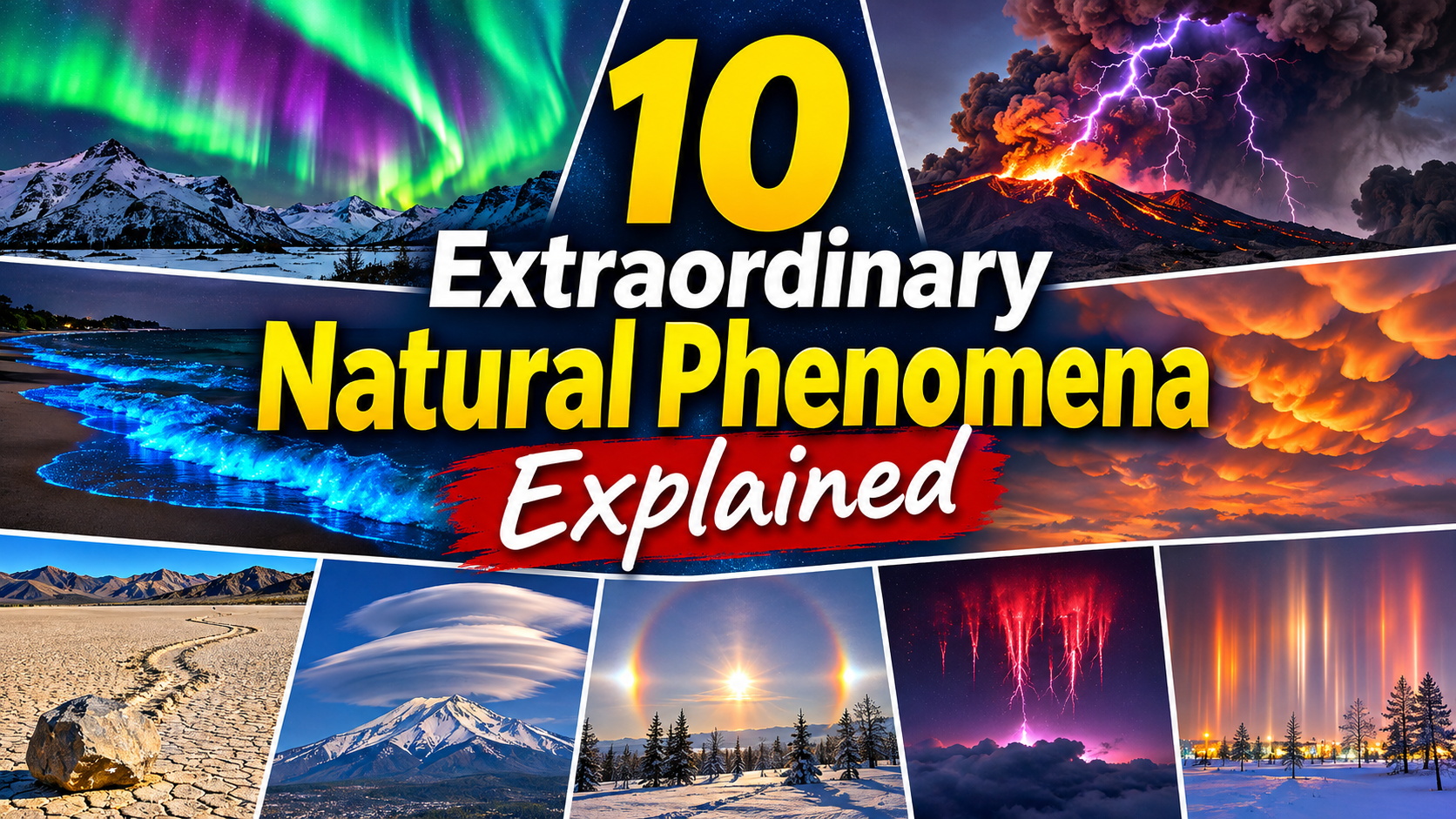

10 Extraordinary Natural Phenomena Explained
Our planet is full of astonishing natural wonders. From glowing oceans and dancing northern lights to mysterious moving rocks and lightning above thunderstorms, Earth produces spectacles that can seem almost supernatural.
Yet behind these extraordinary sights are fascinating scientific processes involving physics, chemistry, biology, geology, and atmospheric science. Let’s explore ten remarkable natural phenomena, understand how they work, and discover where they can be observed.
1. Aurora Borealis – The Dancing Northern Lights


The Aurora Borealis, commonly known as the Northern Lights, is one of nature’s most breathtaking light displays. Brilliant green, pink, purple, and sometimes red curtains appear to dance across the night sky, creating an unforgettable spectacle.
What Causes the Northern Lights?
Auroras occur when charged particles associated with solar activity interact with Earth’s magnetic field and upper atmosphere. Some of these particles travel along magnetic field lines toward polar regions, where they collide with oxygen and nitrogen.
These collisions transfer energy to atmospheric gases. When the gases release that energy, they emit visible light. Oxygen commonly produces green and red emissions, while nitrogen contributes blue and purple colors.
Where to see them: Norway, Iceland, Finland, Alaska, and northern Canada. Similar displays occur in the Southern Hemisphere and are called the Aurora Australis.
2. Bioluminescent Waves – Oceans That Glow Blue


Imagine standing beside the ocean at night and watching every breaking wave glow brilliant electric blue. This incredible natural phenomenon is called marine bioluminescence.
Why Does the Ocean Glow?
Bioluminescence is produced by living organisms through chemical reactions that release light. Certain microscopic marine organisms, especially dinoflagellates, can produce bright flashes when disturbed by waves, swimming animals, or moving boats.
The biochemical reaction generally involves light-producing molecules called luciferins and associated enzymes or proteins.
In some organisms, these flashes may function as a defense mechanism, potentially startling predators or attracting larger animals that feed on them.
Where to see it: Puerto Rico’s Mosquito Bay, parts of the Maldives, and coastal California during suitable plankton blooms. Visibility depends heavily on environmental conditions.
3. Volcanic Lightning – Electrical Storms Inside Eruptions


Explosive volcanic eruptions can generate spectacular lightning within massive clouds of ash. Sometimes called dirty thunderstorms, these events combine the power of geological eruptions with intense electrical activity.
How Does Volcanic Lightning Form?
When volcanoes erupt, ash particles, rock fragments, and gases are ejected into the atmosphere. Collisions and interactions among these materials can create and separate electrical charges.
As charged particles accumulate in different regions of an eruption cloud, an electrical imbalance develops. When the resulting electric field becomes sufficiently strong, lightning discharges occur.
Ice formation and atmospheric moisture can also contribute to electrical charging in large eruption plumes.
Where it occurs: Explosive eruptions worldwide, including those at Sakurajima in Japan and Eyjafjallajökull in Iceland. Volcanic eruptions should only be viewed from officially designated safe locations.
4. Fire Rainbows – Colorful Ice Crystals in the Sky


Sometimes the sky displays brilliant bands of red, orange, yellow, green, and blue that appear to set the clouds on fire. Despite the popular name, fire rainbows have nothing to do with flames.
What Creates a Fire Rainbow?
The scientific name for this phenomenon is a circumhorizontal arc. It forms when sunlight passes through horizontally oriented, plate-shaped ice crystals in high-altitude cirrus clouds.
These crystals refract sunlight, separating it into different colors much like a prism.
For the phenomenon to occur, the Sun must generally be at least 58 degrees above the horizon. This makes geographic location, season, time of day, and cloud conditions especially important.
Where to see it: Areas where the Sun rises high enough in the sky, including parts of Asia, North America, and the Middle East.
5. Sailing Stones – The Mysterious Moving Rocks


In California’s Death Valley National Park, large rocks have left winding tracks across an otherwise flat desert surface. For decades, scientists and visitors wondered how these heavy stones could move without anyone pushing them.
What Makes the Rocks Move?
Researchers eventually documented the unusual combination of shallow water, thin ice, and wind responsible for their movement.
During cold winter conditions, water can collect on the dry lakebed and freeze into thin ice sheets around the rocks.
When temperatures rise, floating ice panels can be pushed by gentle winds. These panels exert force on the stones, moving them across the slippery surface and leaving visible tracks in the mud.
Where to see them: Racetrack Playa in Death Valley National Park, California, United States.
6. Mammatus Clouds – Strange Bubbles Beneath Storms


Mammatus clouds look like giant rounded pouches hanging beneath the sky. Their unusual formations can appear especially dramatic when illuminated by sunset light.
How Do Mammatus Clouds Form?
These cloud structures are associated with complex processes involving sinking air, moisture, evaporation, and atmospheric turbulence.
They often develop beneath the anvils of large cumulonimbus thunderstorm clouds, where pockets of descending air create rounded protrusions.
Mammatus clouds can accompany severe thunderstorms, but they do not automatically mean that a tornado is approaching.
Where to see them: Thunderstorm-prone regions worldwide, including North America, Australia, and parts of the Middle East.
7. Lenticular Clouds – Flying Saucers in the Atmosphere


Lenticular clouds are smooth, lens-shaped formations that often resemble flying saucers. Their symmetrical appearance and sometimes stationary position have inspired UFO reports around the world.
Why Do These Clouds Look Like Spaceships?
Lenticular clouds commonly form when moist, stable air flows over mountains and develops atmospheric waves.
As the air rises within a wave, it cools and water vapor condenses into droplets. When the air descends again, it warms and the droplets evaporate.
This repeated pattern can maintain a nearly stationary cloud even as strong winds continue moving through it.
Where to see them: Mountainous regions such as Mount Fuji in Japan, the Rocky Mountains in North America, and New Zealand’s Southern Alps.
8. Sun Dogs – When Three Suns Appear in the Sky


On certain days, bright patches of light appear on either side of the Sun, creating the illusion of multiple suns in the sky.
This atmospheric optical phenomenon is known as a sun dog, or parhelion.
What Causes Sun Dogs?
Sun dogs form when sunlight passes through hexagonal, plate-shaped ice crystals suspended in the atmosphere.
As these crystals drift with their broad faces nearly horizontal, they refract sunlight at predictable angles. This creates bright patches approximately 22 degrees to either side of the Sun.
Some sun dogs display rainbow-like colors, with reddish tones generally appearing on the side closest to the Sun.
Where to see them: Cold regions such as Canada, Scandinavia, and northern Europe, although suitable ice-crystal clouds can produce them elsewhere.
9. Red Sprites – Giant Lightning Above Thunderstorms


Far above powerful thunderstorms, enormous red electrical flashes sometimes appear for just milliseconds.
These mysterious events, called red sprites, can resemble jellyfish, branching trees, or glowing columns reaching high into the atmosphere.
How Do Red Sprites Form?
Red sprites are transient luminous events produced by electrical activity high above thunderstorms, primarily in the mesosphere.
They are often triggered by powerful cloud-to-ground lightning strikes that rapidly alter the electrical field above the storm.
This electrical disturbance can excite atmospheric gases at high altitudes, producing brief reddish emissions over enormous areas.
Despite their size, sprites are difficult to observe because they appear so quickly and usually occur above distant thunderstorms.
Where to see them: Above major thunderstorm systems worldwide, particularly from distant observation points with clear skies between the observer and the storm.
10. Light Pillars – Glowing Columns in the Night Sky


During cold weather, vertical columns of light sometimes appear to rise above buildings, streetlights, or the Sun itself.
These remarkable formations, known as light pillars, can make an ordinary winter landscape resemble a scene from science fiction.
What Produces Light Pillars?
Light pillars form when light reflects from flat, plate-shaped ice crystals suspended in the atmosphere.
When many of these crystals are oriented nearly horizontally, their reflective surfaces direct light toward an observer from different positions.
This creates the illusion of a tall, luminous column extending above or below the original light source.
Unlike auroras, light pillars do not generate their own light. They are optical reflections of existing natural or artificial light sources.
Where to see them: Cold regions such as Finland, Canada, Alaska, and northern Russia, especially when ice crystals float in the lower atmosphere.
Why Natural Phenomena Are So Fascinating
These extraordinary natural phenomena demonstrate the remarkable complexity of our planet. Some are caused by interactions between sunlight and ice crystals, while others result from microscopic marine organisms, powerful electrical discharges, or unusual geological conditions.
Each phenomenon tells a different scientific story. Auroras reveal the interaction between the Sun and Earth’s magnetic environment. Bioluminescence demonstrates nature’s ability to produce light through chemistry. Volcanic lightning shows how geological processes can generate atmospheric electricity.
Even seemingly mysterious moving stones can be explained through an extraordinary combination of ordinary physical forces.
Conclusion
Nature does not need supernatural forces to create extraordinary sights. Through the laws of physics, chemistry, geology, and biology, our planet continuously produces some of the most beautiful and surprising displays imaginable.
Whether watching the Northern Lights, witnessing glowing waves, or discovering unusual cloud formations, understanding the science makes these experiences even more remarkable.
The next time you look toward the sky, walk beside the ocean, or explore a remote landscape, remember that Earth’s greatest wonders may be hiding in plain sight.