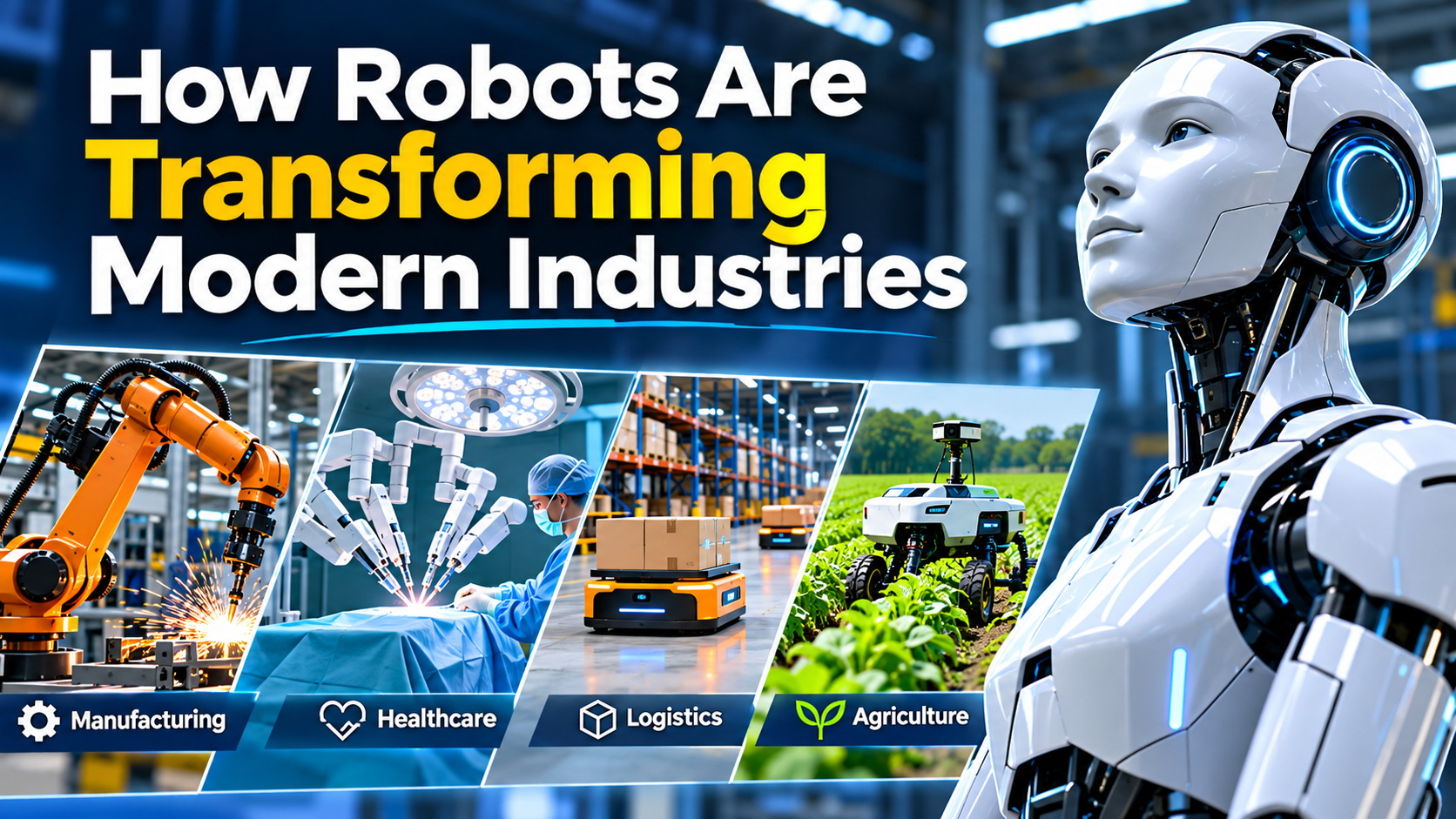

Robots are transforming modern industries by improving productivity, increasing precision, enhancing workplace safety, and changing how businesses operate. Once largely confined to automotive factories, robots now perform important tasks in healthcare, logistics, agriculture, construction, energy, and customer services.
Advances in artificial intelligence (AI), machine vision, sensors, and automation have made modern robots more adaptable. While traditional industrial machines repeat programmed movements, newer robotic systems can interpret their surroundings and respond to changing conditions.

1. Manufacturing: The Rise of Smart Factories
Manufacturing is one of the most established applications of industrial robotics. Robotic arms perform welding, assembly, painting, packaging, materials handling, and quality inspection.
Automotive manufacturers use industrial robots to assemble vehicle bodies and handle components with consistent precision. Electronics manufacturers rely on automation to manipulate delicate parts, while food-processing facilities use robots for sorting and packaging.
Collaborative robots, often called cobots, are designed for applications where people and machines operate in shared workspaces. They can support repetitive assembly, inspection, and machine-tending tasks when appropriate safety measures are implemented.
Main advantages: Increased production consistency, better productivity, reduced repetitive manual work, and improved process monitoring.
2. Healthcare: Robotics in Surgery and Patient Care

Medical robotics is helping healthcare professionals perform certain procedures with specialized instruments and advanced visualization systems.
Robot-assisted surgical technology allows trained surgeons to control miniature instruments during selected minimally invasive operations. These systems can provide enhanced dexterity and precision, although the surgeon remains responsible for the procedure.
Robotic rehabilitation devices can also assist patients with movement training. Hospitals use automated systems to transport medicines, laboratory samples, and medical supplies.
Main advantages: Precise instrument control, support for rehabilitation, and more efficient hospital logistics.
3. Logistics and Warehousing: Automated Fulfillment

Warehouses and distribution centers increasingly depend on robotic automation to move inventory, sort parcels, and support order fulfillment.
Autonomous mobile robots use navigation software and sensors to move through facilities. Some transport shelving units, while others carry containers or deliver goods between workstations.
Advanced warehouse systems combine robots with barcode scanning, computer vision, and inventory-management software to improve visibility and reduce unnecessary movement.
Main advantages: Faster material handling, improved inventory coordination, better space utilization, and reduced manual transportation tasks.
4. Agriculture: Precision Farming and Autonomous Machines

Agricultural robotics is helping farmers manage crops more efficiently and respond to labor shortages.
Specialized machines can assist with planting, precision spraying, mechanical weeding, harvesting, and crop monitoring.
Computer vision helps certain agricultural robots distinguish crops from weeds and identify areas requiring attention. This can reduce unnecessary chemical applications when combined with suitable precision-treatment systems.
However, farming environments remain challenging because weather conditions, uneven terrain, plant variation, and delicate produce can complicate automation.
Main advantages: More targeted field operations, improved monitoring, and reduced demand for repetitive manual tasks.
5. Construction: Bringing Automation to Building Sites
Construction robotics is developing rapidly, although building sites are generally less predictable than factories.
Robotic systems can assist with bricklaying, layout marking, surveying, concrete-related processes, and selected demolition activities.
Some construction technologies use automated equipment to position building materials precisely. Ground robots and drones can also help engineers document progress, inspect structures, and identify potential problems.
Because every construction project has different physical conditions, human supervision and coordination remain essential.
Main advantages: Improved task consistency, assistance with physically demanding work, and more systematic project monitoring.
6. Retail, Hospitality and Delivery Services

Service robots are increasingly used in restaurants, hotels, airports, hospitals, and retail environments.
Mobile robots may deliver food, move supplies, clean floors, or provide basic customer guidance. Certain retail systems can also scan shelves and assist with inventory checks.
These machines are particularly useful for predictable tasks. Human employees remain important for complex requests, problem-solving, and personalized customer experiences.
Main advantages: More efficient routine deliveries, support for service employees, and automated cleaning or inventory operations.
7. Energy and Infrastructure: Robots in Hazardous Environments

Robots are increasingly important in environments that are difficult, dangerous, or time-consuming for humans to access.
Industrial inspection robots may carry cameras, thermal sensors, and specialized instruments to examine equipment in factories, power facilities, and other infrastructure.
Underwater robotic vehicles inspect submerged structures and pipelines, while aerial drones can assess elevated equipment and difficult-to-reach surfaces.
These technologies help organizations collect information without unnecessarily exposing workers to hazardous conditions.
Main advantages: Safer inspection procedures, repeatable data collection, and improved access to challenging environments.
8. Artificial Intelligence and Humanoid Robots

Artificial intelligence is expanding what robots can accomplish. Machine learning, computer vision, and advanced control systems can help robots identify objects, navigate unfamiliar spaces, and adapt to changes.
Humanoid robots have attracted attention because their physical design may make them suitable for environments built around human movement and tools.
Potential applications include materials handling, selected factory tasks, research, and assistance in controlled environments.
Despite significant progress, many humanoid applications remain experimental or limited in commercial deployment. Specialized industrial machines are still more practical for numerous repetitive tasks.
9. Benefits and Challenges of Robotics
| Benefits | Challenges |
|---|---|
| Improved precision and consistency | High initial investment |
| Increased productivity | Maintenance and integration costs |
| Reduced exposure to hazardous tasks | Safety planning and supervision |
| More efficient materials handling | Technical training requirements |
| Improved operational monitoring | Cybersecurity and reliability risks |
| Potential for extended operating hours | Workforce transitions and reskilling |
Implementing robotics requires more than buying automated equipment. Businesses must consider operating costs, system reliability, employee training, workplace safety, and the expected return on investment.
10. Will Robots Replace Human Workers?
Robotics is expected to change many jobs, especially those involving repetitive physical activities in predictable environments.
Some tasks will become automated, while others will be redesigned around cooperation between employees and machines.
At the same time, robotic adoption creates demand for engineers, programmers, maintenance technicians, automation specialists, and workers who supervise intelligent systems.
The impact on employment will vary across industries, occupations, and regions. Education and professional training will be essential for helping workers adapt to technological changes.
11. The Future of Robotics
The next generation of robotics will likely combine artificial intelligence with more advanced sensors, improved mobility, and easier integration into existing business operations.
Important areas of development include:
- Collaborative robotics: More applications involving people and robots working in shared environments.
- Autonomous logistics: Intelligent mobile robots coordinating warehouse and delivery operations.
- Precision agriculture: More targeted crop management and automated field tasks.
- Healthcare robotics: Improved surgical tools, rehabilitation technologies, and hospital automation.
- AI-powered inspection: Automated detection and monitoring of equipment conditions.
- Robotics as a Service: Subscription and leasing arrangements that may reduce upfront deployment costs.
Businesses will increasingly evaluate robotic systems according to measurable results rather than technological novelty alone.
Conclusion
Robots are reshaping modern industries by combining mechanical precision, intelligent software, and increasingly sophisticated automation.
From manufacturing and healthcare to logistics, agriculture, and infrastructure inspection, robotics offers opportunities to improve productivity, safety, and operational efficiency.
Although challenges remain, including cost, reliability, and workforce adaptation, robotics will continue to influence how organizations operate.
The future of industry is likely to depend not on robots replacing every human role, but on people and intelligent machines working together more effectively.
References and Further Reading
- International Federation of Robotics
- National Institute of Standards and Technology — Robotics
- Association for Advancing Automation
- Wikimedia Commons — Image Sources and Licensing
Editorial note: Images are hosted on Wikimedia Commons. Individual image licenses and attribution requirements should be checked before republication. Images are illustrative and do not necessarily depict the specific commercial applications discussed.