
The History of Photography: From Film to Digital Cameras
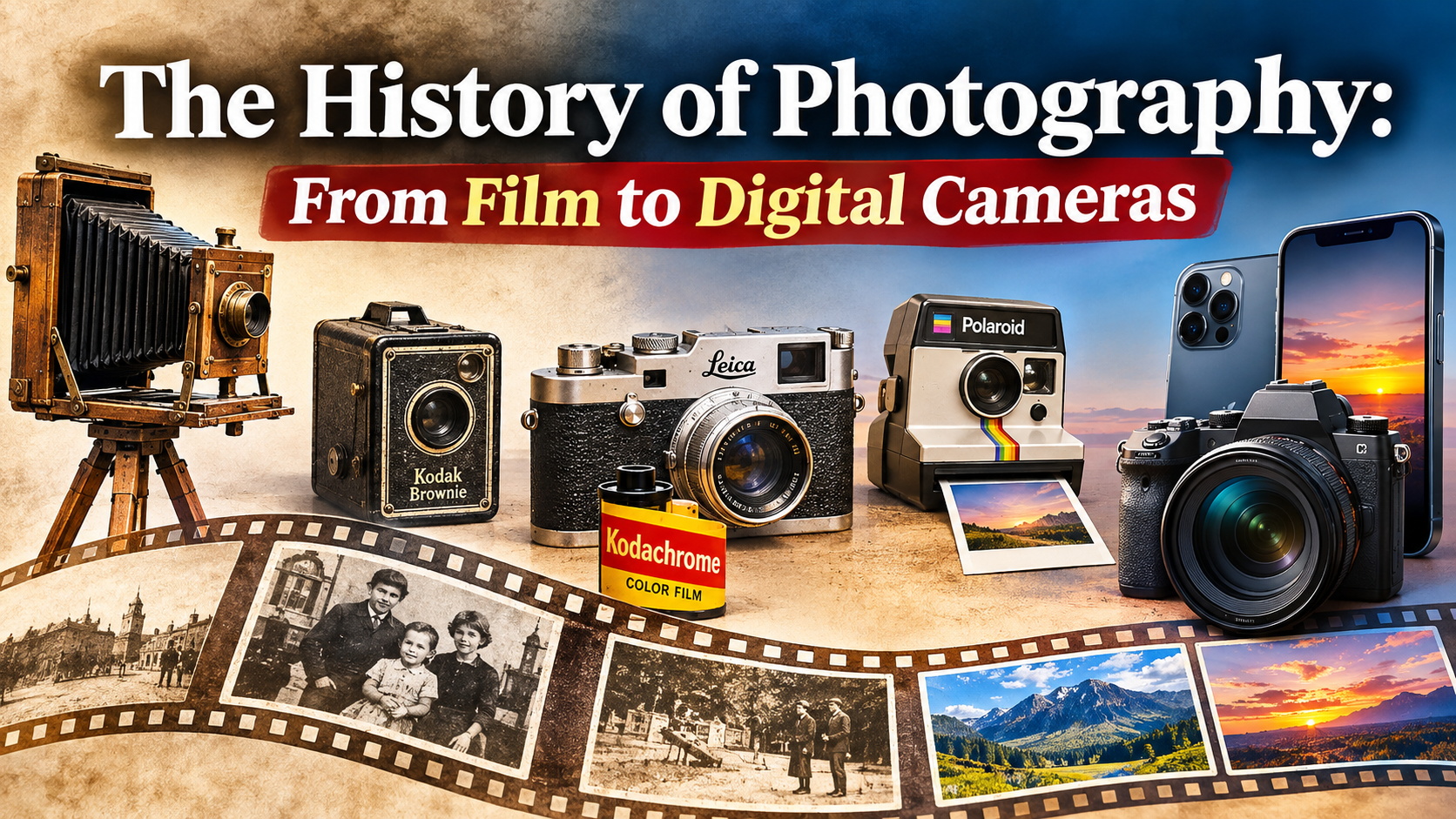
Discover how photography evolved from early chemical experiments and wooden cameras to 35mm film, instant photography, digital sensors, and the powerful smartphone cameras of today.

Photography is one of the most influential inventions in modern history. It has transformed journalism, science, art, travel, education, and the way people preserve personal memories.
Over nearly two centuries, photographers moved from heavy cameras and light-sensitive metal plates to portable film cameras, electronic sensors, and sophisticated digital imaging systems.
1. The Birth of Photography: 1820s–1840s
The foundations of photography emerged from the camera obscura, an optical device that projects an image of the outside world onto a surface through a small opening or lens.
In the 1820s, French inventor Nicéphore Niépce created one of the earliest surviving permanent camera photographs. His famous image, View from the Window at Le Gras, was produced around 1826 or 1827 using a light-sensitive coating on a metal plate.

In 1839, Louis Daguerre publicly introduced the daguerreotype, a photographic process that produced detailed images on silver-coated copper plates.
Early photography required specialized equipment, careful chemical processing, long exposures, and significant financial investment. Even so, these discoveries established photography as a new scientific and artistic medium.
2. The Kodak Film Revolution: 1880s–1920s
The invention and commercialization of roll-film cameras made photography much more practical. American entrepreneur George Eastman founded Kodak and helped transform photography into an activity that ordinary people could enjoy.
In 1888, Kodak introduced a camera using roll film, accompanied by a service that processed the exposed film for customers.
The introduction of the Kodak Brownie in 1900 marked another turning point by offering a simpler and more affordable camera.

Roll film allowed photographers to capture multiple pictures without individually preparing glass or metal plates. It encouraged family albums, holiday photography, travel photography, and everyday snapshot photography.
3. The Rise of 35mm Photography: 1920s–1960s
The 35mm film format had a major influence on the development of modern cameras.
The Leica I, commercially introduced in 1925, helped establish compact 35mm cameras as practical tools for professional and amateur photographers.

Smaller cameras gave photographers greater freedom to document events, city streets, sports, and spontaneous moments.
During the following decades, camera manufacturers introduced increasingly sophisticated lenses, shutters, exposure meters, rangefinders, and single-lens reflex systems.
4. Color Photography and Instant Pictures
Although experimental color methods existed earlier, practical color photography developed substantially during the twentieth century.
The Autochrome process became commercially available in 1907, while the introduction of Kodachrome in 1935 helped establish modern color-film photography.
Color photographs transformed portraits, advertising, magazines, landscapes, and family albums by capturing the visual richness of the world.
Another important innovation arrived in 1948, when Polaroid introduced its first commercially available instant camera.

Instant photography made it possible to produce finished photographs within minutes, reducing reliance on conventional photographic laboratories.
5. The Invention of Digital Photography: 1975
In 1975, Kodak engineer Steven Sasson developed an early self-contained digital camera prototype.
Instead of exposing photographic film, the experimental device used an electronic sensor to capture an image, then stored the information digitally.

The early prototype produced low-resolution monochrome images by modern standards. Nevertheless, it demonstrated an entirely new method of image capture that would eventually transform the photography industry.
6. Digital Cameras Enter the Mainstream: 1990s–2000s
Digital photography advanced significantly during the 1990s. In 1991, the Kodak DCS-100 became an influential early professional digital SLR camera system.
Other manufacturers subsequently introduced digital cameras with improving image resolution, storage capacity, autofocus systems, and usability.
By the 2000s, compact digital cameras and digital single-lens reflex cameras had become widely available.

Digital photography offered substantial practical advantages: photographers could review images immediately, delete unwanted photographs, reuse memory cards, and edit pictures using computers.
These capabilities dramatically changed photojournalism, commercial photography, creative production, and everyday image sharing.
7. Smartphone Photography Changes the World
The integration of cameras into mobile phones introduced another major transformation.
During the 2000s and 2010s, mobile-phone cameras improved in resolution, image processing, autofocus, and video recording quality.
Smartphones combined cameras with editing applications, wireless connectivity, and social platforms, enabling millions of people to document and share everyday experiences.

Modern mobile cameras use advanced computational photography techniques such as high dynamic range imaging, multi-frame processing, portrait effects, night modes, and AI-assisted enhancements.
8. Mirrorless Cameras and Modern Photography
Professional and enthusiast photography has also evolved through the growth of mirrorless interchangeable-lens cameras.
Unlike traditional digital SLR cameras, mirrorless designs do not require a reflex mirror to direct light into an optical viewfinder.
This architecture supports electronic viewfinders, advanced subject tracking, sophisticated autofocus systems, and compact camera designs in many product categories.
Modern cameras are also important video-production tools, with high-resolution recording, advanced stabilization, and professional imaging features.
9. Film Photography vs. Digital Photography
Although digital cameras dominate most mainstream uses, traditional photographic film remains popular among artists, enthusiasts, and collectors.
| Feature | Film Photography | Digital Photography |
|---|---|---|
| Image capture | Light-sensitive photographic film | Electronic imaging sensor |
| Image preview | After development | Usually immediate |
| Storage | Negatives, slides, prints | Memory cards, drives, cloud storage |
| Cost per photograph | Film and development expenses | Generally low after purchasing equipment |
| Editing | Darkroom or digitized film | Digital editing software |
| Image character | Film grain and distinctive tonal response | Flexible sensor output and processing |
| Workflow | Deliberate and development-dependent | Fast and highly flexible |
Film offers a distinctive creative experience, while digital photography provides convenience, speed, extensive editing options, and efficient distribution.
10. Timeline of Photography’s Greatest Milestones
11. The Future of Photography
Photography continues to advance through new sensor technologies, computational imaging, artificial intelligence, and increasingly sophisticated software.
Future innovations may bring better low-light performance, improved dynamic range, more accurate autofocus, faster image processing, and increasingly flexible camera systems.
At the same time, the continued interest in film photography illustrates that the artistic traditions of photography can remain relevant alongside technological development.
Conclusion
From Niépce’s early photographic experiments to the modern digital camera, photography has undergone extraordinary technological change.
Film made photography accessible to millions of people, instant cameras introduced greater convenience, digital sensors transformed image capture, and smartphones placed powerful photographic tools in everyday pockets.
Despite all these innovations, photography continues to serve the same essential purpose: preserving memories, documenting history, and communicating stories through images.