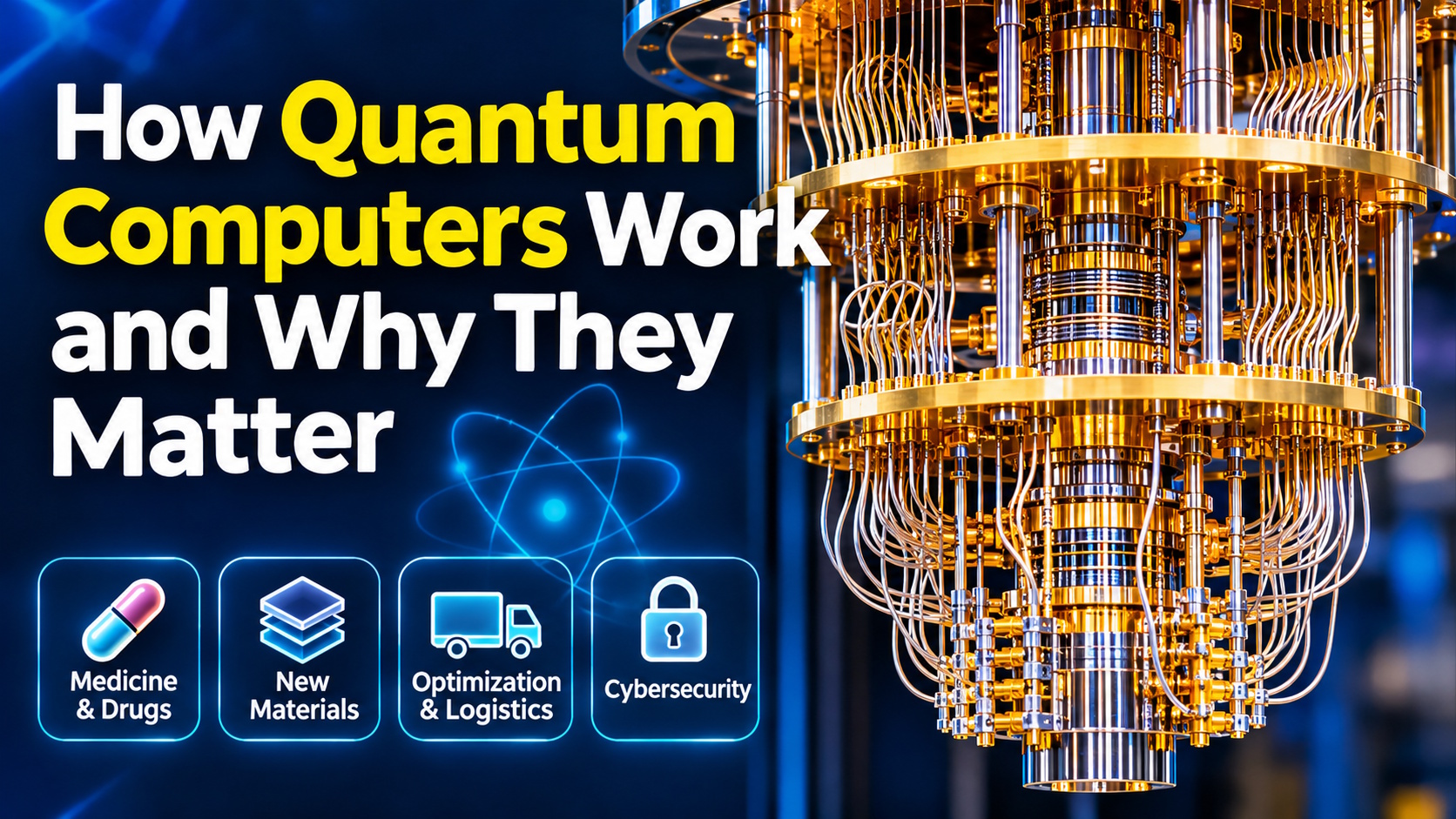

How Quantum Computers Work and Why They Matter
Quantum computing is one of the most exciting developments in modern technology. Unlike traditional computers, which process information using zeros and ones, quantum computers use the unusual properties of quantum physics to tackle certain problems in entirely new ways.

From discovering new medicines to studying advanced materials and preparing for future cybersecurity threats, quantum computers could help researchers solve problems that are extraordinarily difficult for conventional machines.
But how does quantum computing actually work, and why does it matter?
What Is a Quantum Computer?
A quantum computer is a specialized machine that uses the principles of quantum mechanics to process information.
Traditional computers store information in bits. Each bit has a value of either 0 or 1. Quantum computers use quantum bits, known as qubits.
Unlike an ordinary bit, a qubit can exist in a quantum superposition of the states 0 and 1. This allows quantum processors to manipulate information in ways that conventional computers cannot directly reproduce.
However, quantum computers do not simply test every possible answer simultaneously and reveal the correct one. Their real power comes from quantum algorithms that control how different quantum states interact.
How Do Quantum Computers Work?
Quantum computers rely on three essential principles: superposition, entanglement, and interference.
1. Superposition
Superposition allows a qubit to exist in a combination of its basic quantum states before measurement.
For example, a qubit can be prepared so that measuring it produces either 0 or 1 with equal probability.
As qubits are combined, the mathematical space required to describe their collective quantum state increases exponentially.

2. Quantum Entanglement
Entanglement occurs when quantum systems share correlations that cannot be completely explained using classical physics.
When two qubits are entangled, measurements of their states can be strongly related, even when the particles are separated.
Entanglement is an important resource in quantum computing and quantum communication. It does not, however, allow information to travel faster than light.
3. Quantum Interference
Quantum interference allows the probability amplitudes of quantum states to reinforce or cancel one another.
Carefully designed quantum algorithms use interference to increase the probability of useful measurement outcomes and reduce the probability of unwanted results.
This makes interference one of the most important mechanisms behind quantum computational advantages.
How Does a Quantum Computer Perform Calculations?
A quantum calculation generally involves several stages:
- Initialization: Qubits are prepared in a known starting state.
- Quantum gates: Controlled operations change the quantum states.
- Entanglement: Selected qubits are connected through quantum operations.
- Interference: The algorithm shapes the probabilities of possible results.
- Measurement: The qubits are measured to obtain classical information.
- Analysis: Results may be collected across repeated runs and interpreted by classical computers.
Quantum processors can be constructed using superconducting circuits, trapped ions, neutral atoms, photons, or other physical systems.
Some superconducting quantum computers operate at temperatures extremely close to absolute zero to reduce environmental disturbances.

Quantum Computers vs. Classical Computers
Quantum computing is not intended to replace conventional computing in every situation.
| Feature | Classical Computer | Quantum Computer |
|---|---|---|
| Information unit | Bit | Qubit |
| Basic operations | Classical logic | Quantum gates |
| Technology | Transistors | Quantum physical systems |
| Reliability | Highly mature | Challenged by noise |
| Best applications | Everyday computing | Selected specialized problems |
Ordinary computers remain better suited to most everyday tasks, including web browsing, document processing, gaming, and business applications.
Quantum computers could eventually complement them as specialized processors for problems where appropriate quantum algorithms offer significant advantages.
Why Quantum Computers Matter
Medicine and Drug Discovery
Quantum computers could improve researchers’ ability to model molecular behavior and chemical interactions.
More powerful quantum simulations may eventually support the development of medicines and help scientists understand complex chemical processes.
These applications remain research goals rather than widely established commercial capabilities.
Advanced Materials and Batteries
Understanding how electrons behave inside materials is extremely important for chemistry, physics, and engineering.
Quantum simulations could help scientists investigate better catalysts, superconductors, battery materials, and other advanced substances.
Transportation and Logistics
Quantum researchers are exploring algorithms for scheduling, resource allocation, and logistics optimization.
Potential applications include delivery planning and industrial operations. However, researchers have not established that quantum machines will consistently outperform the best classical optimization methods in practical settings.
Cybersecurity and Encryption
One of quantum computing’s most important potential impacts concerns digital security.
A sufficiently powerful, fault-tolerant quantum computer could break certain widely used public-key cryptographic systems.
For this reason, governments and technology organizations are developing and adopting post-quantum cryptography designed to resist attacks from both classical and quantum computers.
What Makes Quantum Computers Difficult to Build?
Quantum states are exceptionally sensitive to noise and unwanted environmental interactions.
Small disturbances can introduce errors, making complex calculations difficult to complete reliably.
Scientists are addressing this challenge through quantum error correction, improved hardware, and increasingly sophisticated control systems.
Quantum error correction uses multiple physical qubits to protect encoded quantum information. The objective is to build reliable logical qubits that can support larger and more accurate calculations.
Increasing the number of physical qubits alone is not sufficient. Their quality, connectivity, and error rates are equally important.
The Future of Quantum Computing
Major technology companies, universities, and specialist research laboratories are investing in quantum computing development.
IBM, Google, and other organizations continue exploring processor designs, error correction, and useful quantum algorithms.
Future quantum systems will likely work alongside classical computers rather than replace them entirely.
The timing of large-scale, broadly useful fault-tolerant quantum computing remains uncertain. Important engineering and scientific challenges must still be overcome.
Will Quantum Computers Change Everyday Life?
Quantum computers may eventually influence everyday life indirectly through improvements in scientific discovery, secure communications, industrial materials, and other technologies.
Most people are unlikely to need a quantum processor in their personal computers or smartphones.
Instead, quantum computing could become part of specialized research centers and cloud computing services that solve particular computational problems.
Conclusion
Quantum computing represents a fundamentally different way of processing information.
By exploiting superposition, entanglement, and interference, quantum computers offer the possibility of solving selected problems that are extremely difficult for traditional machines.
While the technology still faces major limitations, continued advances in quantum hardware, algorithms, and error correction could open new opportunities in science and industry.
The greatest promise of quantum computing is not simply faster computers, but the ability to investigate problems that were previously beyond practical computational reach.
Sources and Further Reading
- IBM — What Is Quantum Computing?
- NIST — Quantum Computing Explained
- NIST — Post-Quantum Cryptography