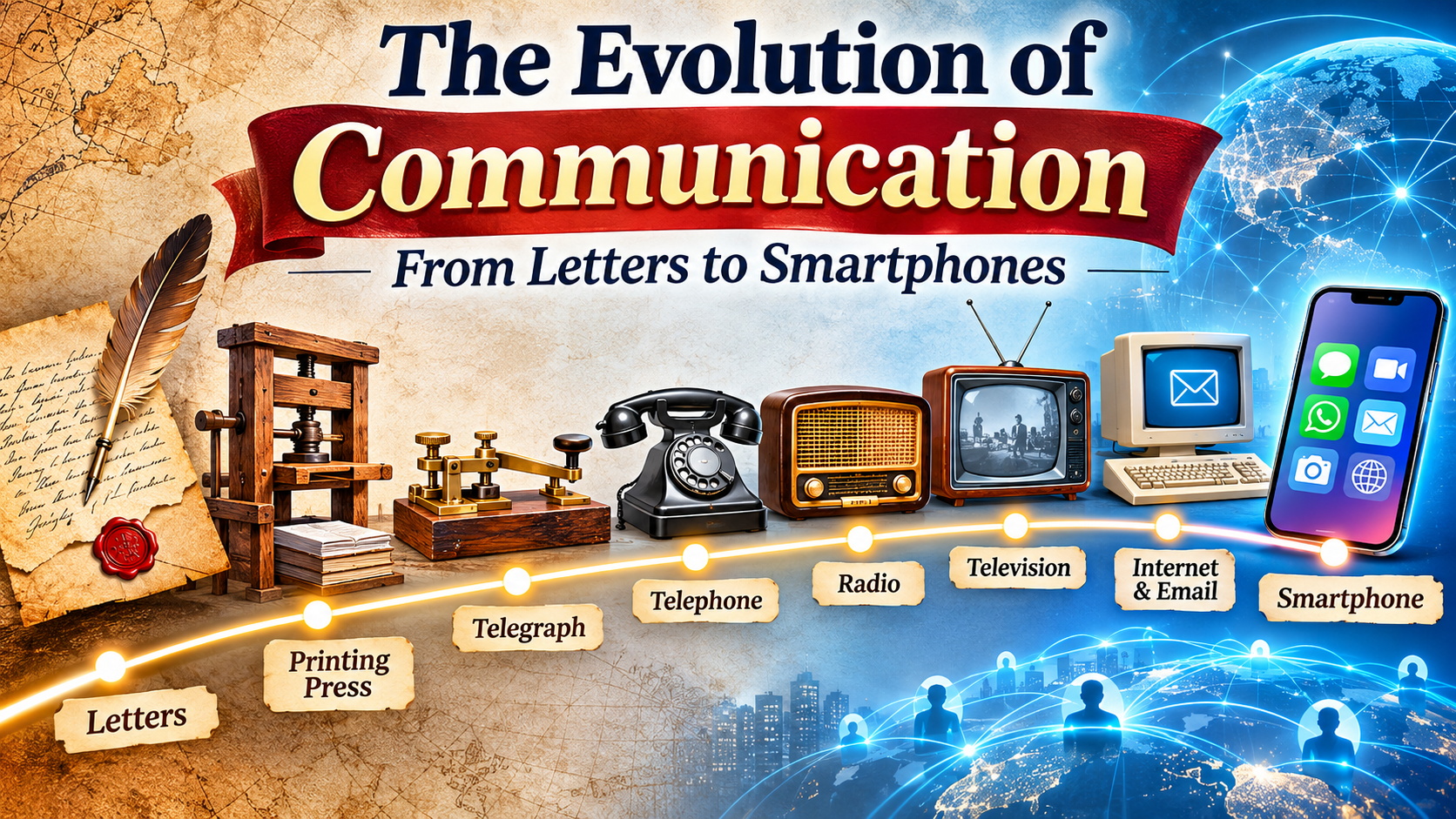

Communication has always been essential to human civilization. From handwritten letters carried across continents to instant video calls connecting people thousands of kilometers apart, the ways humans exchange information have undergone extraordinary transformations.
Each major invention has made communication faster, more accessible, and more interactive. Today, smartphones allow us to send messages, share photographs, attend meetings, and connect with people around the world within seconds.
1. The Age of Handwritten Letters

Before electronic communication, letters were among the most important ways of sending information over long distances.
Ancient civilizations, including the Egyptians, Romans, and Chinese, developed organized systems for delivering written messages. Couriers traveled on foot, horseback, or by ship, sometimes taking weeks or months to reach their destinations.
Letters served many purposes, including personal relationships, government administration, trade, and diplomacy. They also provided a lasting written record of events and decisions.
However, traditional postal communication had significant limitations. Delivery could be expensive, and messages were vulnerable to delays, damage, or loss.
2. The Printing Press Revolution

In the mid-15th century, Johannes Gutenberg helped revolutionize European communication by developing a practical printing system using movable metal type.
Although printing techniques existed in Asia centuries earlier, Gutenberg’s system transformed the production and distribution of books in Europe.
Printed books, pamphlets, and educational materials became easier to reproduce in large quantities. Information could reach audiences much larger than those served by handwritten manuscripts.
The printing revolution contributed to greater access to knowledge and helped accelerate scientific discussion, education, religious debate, and intellectual exchange.
3. The Telegraph: Messages at Electrical Speed

During the 19th century, electrical telegraph systems fundamentally changed long-distance communication.
Samuel Morse and other inventors helped develop telegraph technologies that transmitted information using electrical signals.
Morse code represented letters and numbers through combinations of short and long signals, commonly called dots and dashes.
Unlike physical letters, telegraph messages could travel across vast distances in minutes rather than days.
Commercial telegraph networks expanded during the 1840s. They supported newspapers, financial markets, railway operations, international trade, and government communication.
The successful transatlantic telegraph cable of 1866 established a durable communications link between Europe and North America.
4. The Telephone: Hearing Voices Across Distances

The telephone introduced a revolutionary improvement: people could hear one another’s voices without being physically present.
Alexander Graham Bell received an important United States telephone patent in 1876, although several inventors contributed to the development of telephone technology.
Telephone networks gradually expanded into businesses, government offices, and households. People could discuss important matters directly instead of exchanging written messages.
Later developments included automatic telephone switching, international calling, submarine telephone cables, and digital networks.
The telephone became one of the most influential technologies of modern life, transforming personal relationships and business operations.
5. Radio and Television: Reaching Millions
Radio introduced wireless communication on a large scale. Developments in electromagnetic technology during the late 19th and early 20th centuries made radio transmission increasingly practical.
Radio broadcasting allowed news, music, educational programs, and emergency announcements to reach enormous audiences simultaneously.
Television expanded this capability by adding moving images and sound.
Families could watch important political events, international developments, sporting competitions, and cultural programs from their homes.
Radio and television shifted communication beyond individual conversations toward mass media, helping shape public opinion and modern global culture.
6. Computers, Email, and the Internet

The second half of the 20th century introduced digital communication, changing the way information was created, stored, and exchanged.
Early computer networks laid the foundations for today’s internet. Networked email developed during the 1970s, allowing users to exchange electronic messages between computers.
In 1989, Tim Berners-Lee proposed the system that became the World Wide Web while working at CERN.
The web made it easier for people to publish information and navigate between documents using hyperlinks.
During the 1990s and 2000s, email, websites, online discussion forums, instant messaging, and internet-based communication became increasingly common.
Businesses began using digital communication for customer support, marketing, collaboration, and international operations.
7. Mobile Phones: Communication on the Move

Mobile phones removed the need to remain near a fixed telephone connection.
Early cellular phones were large, expensive, and primarily designed for voice calls. As technology advanced, they became smaller, more reliable, and more affordable.
The growth of cellular networks made it possible for people to communicate while traveling, working, or moving between locations.
Short Message Service, commonly known as SMS, introduced a convenient way to send short written messages without making a telephone call.
By the early 2000s, many mobile phones included built-in cameras, multimedia messaging, games, and basic internet access.
8. Smartphones and Instant Global Connectivity

Smartphones combined telephone communication, computing, internet access, digital photography, and entertainment into a portable device.
The introduction of Apple’s iPhone in 2007 and the first commercial Android smartphones in 2008 helped accelerate a major shift toward touchscreen devices and mobile applications.
Modern smartphones support a remarkable range of communication activities:
- Instant text and multimedia messaging
- High-quality voice and video calling
- Email and professional collaboration
- Social media and content sharing
- Live streaming and online broadcasting
- Real-time language translation
- Cloud-based file sharing
- Emergency alerts and location sharing
Messaging applications, including WhatsApp, Telegram, and other platforms, have made global communication remarkably convenient.
Smartphones also play important roles in education, banking, healthcare, navigation, and business operations.
However, constant connectivity has created new challenges involving digital privacy, cybersecurity, misinformation, excessive screen time, and online harassment.
9. Timeline of Communication Technology
| Period | Technology | Major Impact |
|---|---|---|
| Ancient civilizations | Written letters and couriers | Recorded long-distance messages |
| Mid-1400s | European printing revolution | Wider distribution of knowledge |
| 1840s | Commercial electrical telegraph | Rapid long-distance messaging |
| 1876 | Bell’s telephone patent | Electrical voice communication |
| Early 1900s | Radio broadcasting | Wireless mass communication |
| Mid-1900s | Widespread television | Mass audiovisual communication |
| 1970s | Networked email | Digital written communication |
| 1990s | Expansion of the World Wide Web | Global information sharing |
| 2000s | Modern smartphones and mobile apps | Portable digital connectivity |
| 2020s | AI-assisted communication | Translation and automation |
10. The Future of Communication
Communication technology continues to evolve through artificial intelligence, increasingly capable digital networks, and immersive systems.
AI-powered translation tools can help people communicate across language barriers. Speech recognition and generative AI can assist with writing, summarizing conversations, and answering questions.
Augmented reality and virtual reality may introduce more immersive forms of remote collaboration, education, and social interaction.
Improved satellite connectivity could expand communication access in remote areas where traditional network infrastructure is limited.
At the same time, future communication systems will need to address privacy protection, information authenticity, accessibility, and responsible AI use.
11. How Communication Changed Human Society
The history of communication is not simply a history of technological inventions. It is also the story of how societies became more connected.
Faster communication has transformed international trade, education, scientific collaboration, healthcare, diplomacy, and personal relationships.
Information that once required weeks to travel across continents can now be shared around the world almost instantly.
Nevertheless, the speed of modern communication does not automatically guarantee accuracy, understanding, or meaningful human connection.
The most successful communication technologies are those that make information more accessible while supporting trust, clarity, and genuine interaction.
Conclusion
The evolution of communication demonstrates humanity’s ongoing effort to overcome distance, time, and language barriers.
Handwritten letters enabled lasting long-distance relationships. Telegraphs and telephones introduced rapid communication. Radio and television connected mass audiences, while computers and the internet created a global digital information network.
Today, smartphones place many of these technologies into a single device that fits in a pocket.
As artificial intelligence and emerging technologies reshape communication, one fundamental purpose remains unchanged: sharing knowledge, exchanging ideas, and connecting people.