
The Future of Technology: What Comes Next?
Technology & Innovation | October 2026 | 9-minute read


9
Technology is evolving faster than ever. From artificial intelligence that can perform increasingly complex tasks to robots working alongside humans, the innovations of today are laying the foundation for a dramatically different tomorrow.
But what comes next? Will robots transform everyday life? Could quantum computers revolutionize scientific discovery? Will artificial intelligence change how we work, learn, and communicate?
The future of technology is not defined by one invention. It is being shaped by the convergence of several powerful developments that could transform nearly every industry.
According to the 2026 McKinsey Technology Trends Outlook, the technological frontier is expanding beyond software into physical systems, including robotics, energy infrastructure, advanced computing, and scientific discovery.
McKinsey & Company
1. Artificial Intelligence: From Chatbots to Digital Coworkers

Artificial intelligence is moving beyond answering questions and generating content. The next stage involves AI systems that can plan, use software tools, coordinate multiple steps, and help complete real-world tasks.
These systems are commonly called AI agents.
Imagine an AI assistant capable of organizing business operations, analyzing customer preferences, preparing reports, scheduling appointments, and managing routine administrative work with human oversight.
Stanford’s 2026 AI Index reports that organizational AI adoption reached 88%, showing how quickly the technology has entered workplaces. However, AI agents still make mistakes, particularly on complicated multistep tasks.
Stanford HAI
What comes next? Between 2027 and 2030, AI assistants may become more integrated into everyday business software, education, healthcare administration, and personal productivity.
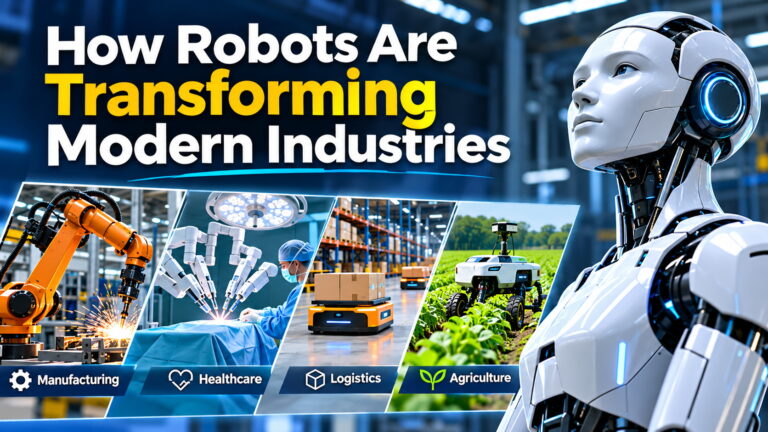
2. Robotics: Intelligent Machines Enter Everyday Life

Robotics is entering a new phase as developments in AI, cameras, sensors, and motion control make machines more adaptable.
Industrial robots have operated in factories for decades. The emerging opportunity is to build robots that can handle more varied environments and tasks.
Potential applications include:
- Warehouse automation and package handling.
- Hospital logistics and medical assistance.
- Agricultural harvesting and crop monitoring.
- Inspection of dangerous industrial locations.
- Home assistance and support for older adults.
The major challenge is reliability. Real-world environments are unpredictable, and robots must operate safely around people.
What comes next? Specialized robots are likely to spread faster than general-purpose household humanoids. Affordable robots capable of performing many unrelated household chores remain a longer-term possibility.
3. Quantum Computing: A Different Kind of Computing Power

Traditional computers process information using bits represented as zeros and ones. Quantum computers use quantum bits, or qubits, which exploit quantum phenomena to perform certain calculations differently.
Quantum computing is not expected to replace laptops or smartphones. Its potential lies in solving specialized problems that can be extremely difficult for conventional computers.
Researchers are exploring quantum applications in molecular simulation, advanced materials, chemistry, and selected optimization problems.
However, quantum systems are sensitive to noise, and building sufficiently reliable, error-corrected machines remains a major engineering challenge.
What comes next? More capable experimental systems and progress toward fault-tolerant quantum computing. The timeline for widespread commercial advantages is still uncertain.
4. Healthcare Technology: More Personalized Medicine

Healthcare could become one of the greatest beneficiaries of technological progress.
AI is being developed to support medical imaging, drug discovery, clinical documentation, and research. Meanwhile, advances in biotechnology and wearable sensors are creating new opportunities to monitor health and develop targeted treatments.
Potential breakthroughs include earlier disease detection, better matching of treatments to individuals, improved medical robotics, and faster discovery of promising drug candidates.
IEEE’s 2026 technology predictions highlight adaptive therapeutic systems that could interpret biological signals and adjust treatment in real time.
IEEE Computer Society
What comes next? Greater use of carefully validated AI decision-support tools and personalized treatments, subject to clinical evidence, regulation, privacy protections, and medical oversight.
5. Clean Energy and Smarter Power Systems

Tomorrow’s technology will require enormous amounts of reliable electricity.
Solar power, wind energy, advanced batteries, smarter electrical grids, and new nuclear technologies are all part of the energy conversation. Software and AI may help utilities forecast electricity demand, detect failures, and optimize grid operations.
The International Energy Agency projects that global data-center electricity consumption could approximately double from 485 terawatt-hours in 2025 to 950 terawatt-hours in 2030.
IEA
This creates both an opportunity and a challenge: technology can help improve energy efficiency, but its own expanding infrastructure consumes significant resources.
What comes next? Investment in energy storage, efficient chips, upgraded electricity networks, and reliable low-carbon power generation.
6. Extended Reality: Blending Digital and Physical Worlds

Augmented reality (AR), virtual reality (VR), and mixed reality are changing how people experience digital information.
Instead of viewing everything through conventional screens, users may increasingly interact with digital objects placed inside their physical surroundings.
Possible applications include interactive classrooms, immersive entertainment, virtual property tours, industrial training, and three-dimensional design.
The greatest barriers remain comfort, device cost, battery life, and finding applications valuable enough for everyday use.
What comes next? More practical AR glasses and specialized immersive tools, although the replacement of smartphones by smart glasses is far from certain.
7. Autonomous Transportation: Smarter Mobility

Cars, buses, aircraft, and logistics vehicles are becoming more connected and increasingly automated.
Self-driving vehicles already operate in selected environments, while driver-assistance systems continue to improve. The next challenge is extending autonomous systems safely into more complex locations and conditions.
Future transportation could feature more automated delivery vehicles, intelligent traffic management, autonomous industrial transport, and expanded electric mobility.
What comes next? Gradual growth of autonomous services in carefully mapped or controlled environments, rather than an immediate transition to fully driverless transportation everywhere.
8. Space Technology: A New Era of Exploration

Space technology is becoming increasingly important to everyday life.
Satellites enable navigation, weather observation, communications, environmental monitoring, and scientific research. Advances in reusable launch systems are also making new missions and commercial applications possible.
In the coming decade, space technology may expand through satellite internet networks, improved Earth observation, lunar exploration, and more sophisticated robotic missions.
Major obstacles include launch costs, orbital debris, technological reliability, and international coordination.
What comes next? More capable satellite services and robotic space exploration, while large-scale settlement beyond Earth remains a distant and uncertain prospect.
9. Cybersecurity: Protecting an Increasingly Connected World
As more devices, vehicles, businesses, and infrastructure systems become connected, cybersecurity becomes increasingly critical.
AI can help defenders detect suspicious activity, but it can also be misused to create convincing scams, impersonate people, or automate attacks.
Future security strategies will place greater emphasis on identity verification, secure software development, resilient infrastructure, and preparing for cryptographic threats from sufficiently advanced quantum computers.
What comes next? Security will become a core requirement of digital products rather than something added after development.
10. The Future of Work: Humans and Machines Together
Technology will not affect every profession in the same way.
Some routine tasks may become automated, while other jobs will evolve to involve supervising AI, interpreting results, designing workflows, managing relationships, and solving problems that require human judgment.
Skills such as technological literacy, adaptability, critical thinking, creativity, and domain expertise are likely to remain valuable.
The central question is not simply whether machines can perform more work. It is how organizations and societies distribute the benefits, manage transitions, and protect people whose roles are disrupted.
Technology timeline: What might happen next?
The following is an illustrative forecast, not a guaranteed prediction.
| Period | Developments to watch |
|---|---|
| 2027–2030 | More AI agents, specialized robots, improved wearables, and smarter energy systems |
| 2030–2035 | Broader autonomous transport deployments, advanced medical technologies, and more sophisticated robotics |
| 2035–2040 | Potential breakthroughs in fault-tolerant quantum computing, biotechnology, and industrial automation |
| Beyond 2040 | More speculative possibilities, including widespread household robotics, advanced human-machine interfaces, and ambitious space infrastructure |
The biggest challenges ahead
Technological progress is not automatically social progress. Every major innovation creates questions about how it should be developed and used.
Privacy, cybersecurity, economic inequality, access to education, misinformation, environmental costs, and concentration of technological power will become increasingly important issues.
Successful adoption will depend not only on powerful technology but also on responsible design, public trust, regulation, and reliable infrastructure.
Conclusion: The Future Is Being Built Today
The next decade could be one of the most transformative periods in technological history.
Artificial intelligence may become a regular collaborator at work. Robots could handle more physical tasks. Medical research may move faster, transportation may become more automated, and digital experiences may blend more naturally into everyday environments.
Yet the most important breakthroughs may come from combining technologies rather than advancing them individually.
The future of technology is not simply about creating smarter machines. It is about using innovation to improve human lives while understanding its risks and limitations.
SEO publishing package
SEO title Copy
The Future of Technology: 10 Innovations Shaping Tomorrow
URL slug Copy
future-of-technology-what-comes-next
Meta description Copy
Explore the future of technology, from AI and robotics to quantum computing, healthcare, smart energy, and the innovations shaping tomorrow.
Focus keyword: Future of Technology
Secondary keywords: Technology Trends 2026, Artificial Intelligence, Future Innovations, Robotics, Quantum Computing, Emerging Technologies
Suggested category: Technology & Innovation
Suggested tags: AI, Robotics, Quantum Computing, Future Technology, Smart Cities, Biotechnology, Space Exploration
References and further reading
- Stanford University — 2026 AI Index Report
- McKinsey — Technology Trends Outlook 2026
- International Energy Agency — Key Questions on Energy and AI
- IEEE — Technology Predictions for 2026
Editorial status: Article and SEO package prepared. Images shown are illustrative visual references, not a verified licensed media package. No website publication has been performed.