


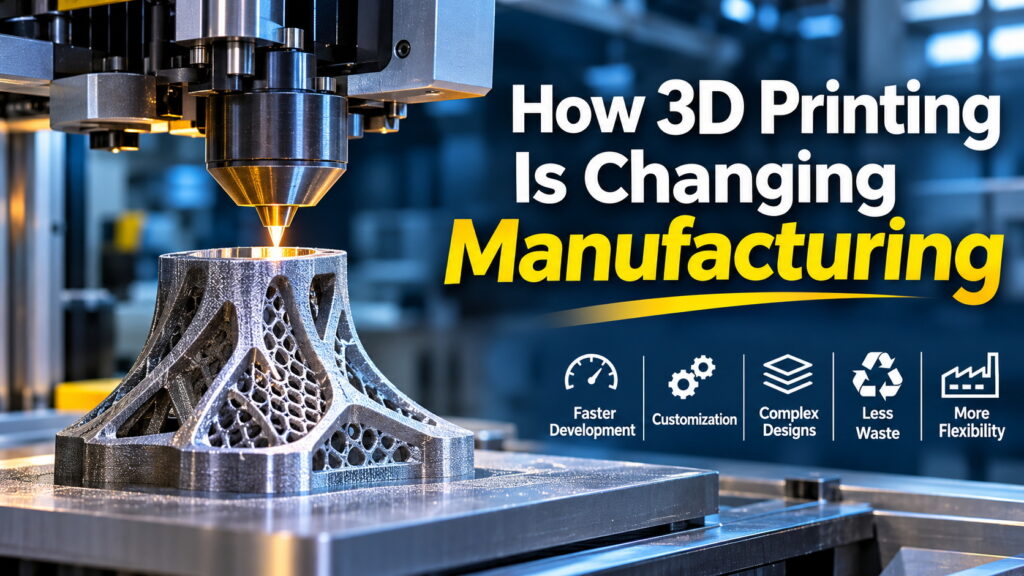
How 3D Printing Is Changing Manufacturing
3D printing is transforming modern manufacturing by enabling faster product development, complex designs, customized components, and more flexible production methods. From aerospace and automotive engineering to healthcare and construction, additive manufacturing is reshaping how products are created.


Unlike conventional processes that remove material from a larger block or require specialized molds, many 3D printing technologies build objects one layer at a time from digital models.
Although the technology originally became popular for rapid prototyping, industrial systems can now produce functional components for demanding real-world applications.
What Is 3D Printing?
3D printing, also known as additive manufacturing, is a process that creates three-dimensional objects using computer-generated designs.
The manufacturing process typically follows five steps:
- Digital design: Engineers create a 3D model using computer-aided design (CAD) software.
- Model preparation: Specialized software divides the design into printable layers and prepares machine instructions.
- Material preparation: A suitable material, such as polymer filament, resin, or metal powder, is loaded into the system.
- Printing: The machine creates the component layer by layer.
- Post-processing and inspection: Depending on the application, the object may require cleaning, heat treatment, machining, and quality testing.
Different printing methods use different techniques. Some melt plastic filament, others cure liquid resin using light, while industrial metal systems can fuse metal powder using lasers or electron beams.
1. Faster Product Development and Prototyping
One of the biggest advantages of 3D printing is the ability to develop and test new products more quickly.
Traditional prototyping can require special tools, manufacturing equipment, and lengthy production preparation. With additive manufacturing, engineers can often transform a digital design into a physical prototype without producing a dedicated mold.
This allows companies to:
- Test new product concepts quickly.
- Identify design problems earlier.
- Create multiple prototype versions.
- Reduce certain development costs.
- Shorten the time required to launch new products.
Manufacturers can also experiment with unusual shapes and internal structures before committing to full-scale production.
2. More Customization and Personalized Products
Traditional manufacturing is often optimized for producing large quantities of identical products. Changing the design can require additional tooling, materials, and setup expenses.
3D printing makes individual customization more practical because many changes can be made directly in the digital design.
For example, medical professionals can use additive manufacturing to produce patient-specific surgical guides, dental devices, and selected medical implants.


Customization is also becoming valuable for jewelry, eyewear, specialized industrial equipment, and limited-edition consumer products.
3. Complex Designs and Lightweight Components
Some of the greatest opportunities in additive manufacturing come from design freedom.
Conventional manufacturing methods can struggle to produce complicated internal channels, hollow structures, and intricate geometric patterns.
3D printing can create these features directly, allowing engineers to design parts that combine multiple functions or use less material.


In the aerospace industry, lower component weight can contribute to improved fuel efficiency. Engineers can also combine several conventionally manufactured pieces into one integrated component, reducing assembly requirements.
4. Reduced Material Waste
Conventional subtractive manufacturing often removes unwanted material through cutting, drilling, or machining.
By building components with material added where needed, certain 3D printing processes can substantially reduce waste.
This is particularly attractive when manufacturing components from expensive metals.
However, additive manufacturing is not automatically more sustainable. Energy consumption, failed prints, support structures, unused powders, and post-processing must be considered when evaluating its environmental impact.
5. On-Demand Manufacturing and Spare Parts
Many manufacturers maintain large inventories of replacement parts to support machinery and equipment over long periods.
3D printing creates opportunities to manufacture selected replacement parts when required rather than maintaining extensive physical inventories.
Potential advantages include:
- Reduced storage requirements.
- Faster production of certain low-volume components.
- Improved support for discontinued equipment.
- Greater flexibility in remote manufacturing locations.
- Reduced dependence on some specialized suppliers.
Not every replacement part can be printed safely or economically. Critical components still require appropriate materials, testing, and manufacturing certification.
6. More Flexible Production and Factory Operations
3D printing is also used within factories to produce manufacturing tools, assembly fixtures, and equipment accessories.
A company may print a customized tool instead of ordering it from an external supplier, potentially reducing the time required to implement production improvements.
This supports more flexible manufacturing environments where digital designs can be updated quickly.
Industries Using 3D Printing
Aerospace
Aircraft and spacecraft manufacturers use additive manufacturing to develop lightweight structures, complex engine components, and specialized equipment.


Automotive
Car manufacturers use 3D printing for concept models, prototypes, testing equipment, custom tooling, and certain finished components. It is especially valuable for specialized and low-volume production.
Healthcare
Applications include dental restorations, surgical planning models, patient-specific implants, and prosthetic devices. Medical products must meet applicable safety and regulatory requirements.
Construction
Large-scale systems are being developed to print building elements using concrete-like materials. This can change how some walls and structural forms are constructed, although reinforcement, inspections, and conventional construction processes remain necessary.
Consumer Products
3D printing is used to develop customized jewelry, footwear components, home accessories, and specialized lifestyle products. It can make small production runs more practical for independent designers.
3D Printing vs. Traditional Manufacturing
| Factor | 3D Printing | Traditional Manufacturing |
|---|---|---|
| Prototyping | Often faster | May require more tooling |
| Customization | Highly flexible | Often more expensive |
| Mass production | Often less economical | Usually more efficient |
| Complex geometries | Strong design freedom | May require multiple processes |
| Material waste | Can be lower | Varies by process |
| Quality control | Requires process validation | Established industrial methods |
In practice, many manufacturers achieve the best results by combining additive manufacturing with traditional machining, molding, and assembly techniques.
Real-World Example: GE Aerospace
A notable industrial example comes from GE Aerospace and the LEAP aircraft engine.
Engineers redesigned a fuel nozzle tip that previously consisted of approximately 20 components into a single additively manufactured piece.
According to GE Aerospace, the redesigned nozzle tip was approximately 25% lighter, while the simplified structure reduced assembly requirements.
In 2018, the company announced that its Auburn, Alabama manufacturing facility had produced 30,000 additive fuel nozzle tips.
This achievement demonstrated how 3D printing could move beyond prototype development into industrial component production.
Source: GE Aerospace – Manufacturing Milestone: 30,000 Additive Fuel Nozzles
Challenges of 3D Printing
Despite its advantages, additive manufacturing has important limitations.
- Production costs: Industrial machines and specialized materials can be expensive.
- Production speed: High-volume conventional processes may produce identical components more quickly.
- Material availability: The range of suitable printable materials depends on the process.
- Quality consistency: Mechanical properties and dimensional accuracy require careful control.
- Post-processing: Components may need surface finishing, machining, or heat treatment.
- Technical expertise: Industrial printing requires skilled design and manufacturing professionals.


The Future of 3D Printing in Manufacturing
The future of additive manufacturing is closely connected to advances in artificial intelligence, automation, materials science, and digital production systems.
AI-Assisted Design
Artificial intelligence and generative design tools can help engineers explore optimized shapes, lightweight structures, and alternative component configurations.
Advanced Printing Materials
Research into new metal alloys, polymers, composites, and ceramics could broaden the range of applications suitable for 3D printing.
Automated Manufacturing
Integrated systems combining printers, robotics, process sensors, and automated inspection may improve productivity and consistency.
Distributed Production
Digital manufacturing could allow certain qualified components to be produced closer to customers or equipment operators, reducing some inventory and transportation requirements.
These developments will depend on improvements in cost, reliability, material performance, and manufacturing standards.
Conclusion
3D printing is changing manufacturing by enabling faster product development, greater customization, and more complex engineering designs.
Its ability to produce components from digital models is helping companies rethink traditional production methods and develop more flexible operations.
Although additive manufacturing will not replace every conventional process, it is becoming an increasingly valuable tool for industries that require innovation, precision, and specialized production.