


SCIENCE • NEUROSCIENCE • EDUCATION
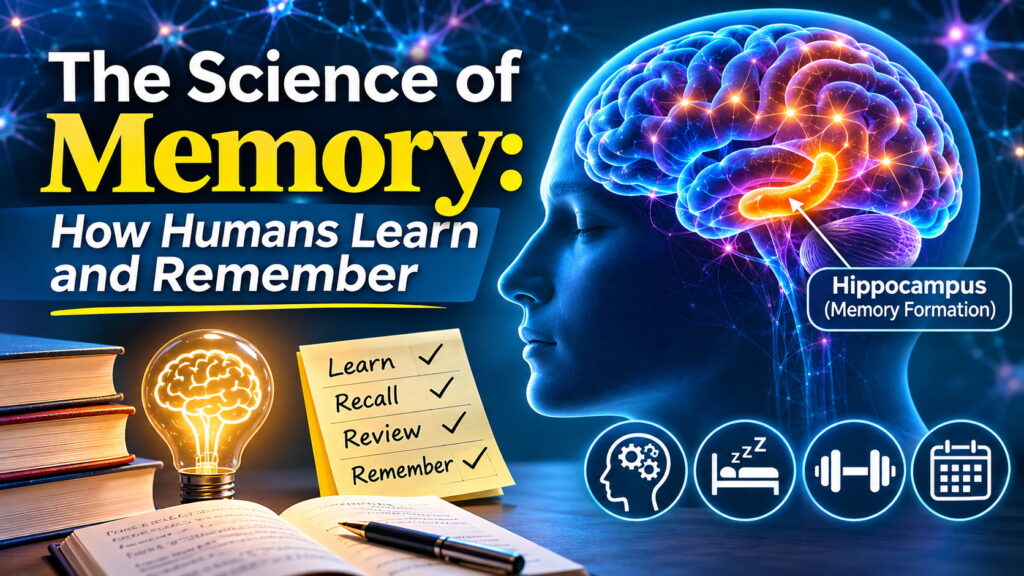
The Science of Memory: How Humans Learn and Remember
Exploring the extraordinary biological mechanisms behind human learning, knowledge and memory.


Memory is one of the most extraordinary abilities of the human brain. It allows us to acquire knowledge, develop skills, recognize people, recall experiences and make decisions based on the past.
Unlike a digital storage device, human memory is a dynamic biological process involving billions of neurons, electrical signals, chemical messengers and interconnected brain regions. Every new experience has the potential to reshape the brain through a process known as neuroplasticity.
Memory at a Glance
- Brain neurons: Approximately 86 billion.
- Core processes: Encoding, storage and retrieval.
- Key brain structure: Hippocampus.
- Essential biological mechanism: Neuroplasticity.
- Effective learning strategies: Active recall and spaced repetition.
- Important supporting factor: Quality sleep.
1. How Human Memory Works
Human memory involves three fundamental stages that allow information to be acquired, retained and accessed.
01 — Encoding
Transforming information from experiences, observations and learning into memory representations.
02 — Storage
Maintaining information over time through changes in neural networks and synaptic connections.
03 — Retrieval
Accessing and reconstructing previously learned information when it is needed.
Attention, repetition, emotional significance and existing knowledge influence how effectively information moves through these stages.
2. The Different Types of Human Memory


| Memory Type | Duration | Example |
|---|---|---|
| Sensory Memory | Milliseconds to seconds | Seeing a passing car |
| Short-Term Memory | Seconds to minutes | Remembering a phone number |
| Working Memory | During active processing | Solving a mathematical problem |
| Long-Term Memory | Hours to a lifetime | Remembering childhood experiences |
Long-Term Memory Categories
- Episodic memory: Personal experiences and events.
- Semantic memory: Facts, meanings and general knowledge.
- Procedural memory: Learned skills such as driving, cycling and swimming.
- Implicit memory: Learned associations and responses that can operate without conscious awareness.
3. The Brain Regions Responsible for Memory


Memory is not stored in a single location. Instead, different brain regions cooperate to process, maintain and retrieve information.
| Brain Region | Primary Function |
|---|---|
| Hippocampus | Formation of new declarative memories. |
| Prefrontal Cortex | Working memory, attention and decision-making. |
| Amygdala | Emotional learning and memory. |
| Cerebellum | Motor learning and coordination. |
| Basal Ganglia | Habit formation and procedural learning. |
| Neocortex | Distributed representation of long-term knowledge. |
4. How Neurons Create Memories


The human brain contains approximately 86 billion neurons. These specialized cells communicate through electrical and chemical signals at connections called synapses.
When humans learn something new, neural activity can modify the strength and organization of these connections. This remarkable ability is known as neuroplasticity.
Long-Term Potentiation
Long-term potentiation, commonly abbreviated as LTP, is a biological mechanism in which certain patterns of neural stimulation produce lasting increases in synaptic strength.
Alongside other forms of synaptic plasticity, this mechanism helps explain how experience and practice can produce lasting changes in the brain.
The Learning Process
New Experience
↓
Neural Activity
↓
Synaptic Changes
↓
Memory Formation and Consolidation
5. Why Humans Forget
Forgetting is a natural part of human cognition. It allows the brain to prioritize relevant information and adapt to changing circumstances.
Common causes of forgetting include:
- Insufficient attention during learning.
- Weak initial encoding of information.
- Interference from similar memories.
- Inadequate sleep and excessive stress.
- Difficulty retrieving stored information.
- Changes in memory representations over time.
The Forgetting Curve
German psychologist Hermann Ebbinghaus pioneered the scientific study of memory and forgetting during the nineteenth century. His research demonstrated that newly learned information can be forgotten rapidly without reinforcement.
Illustrative Forgetting Curve
Immediately after learning
After a short period
After further time without review
Later without reinforcement
Conceptual illustration only. Actual memory retention varies according to the individual, material and learning conditions.
6. The Importance of Sleep for Memory


Sleep plays a fundamental role in memory consolidation. During sleep, the brain can reactivate patterns associated with previous experiences and integrate newly acquired information with existing knowledge.
Both non-REM and REM sleep contribute to different aspects of learning and memory processing.
- Supports the consolidation of newly acquired knowledge.
- Contributes to motor skill learning.
- Supports emotional memory processing.
- Helps maintain attention and cognitive performance.
- Prepares the brain for subsequent learning.
Most healthy adults should aim for approximately seven to nine hours of sleep per night.
7. Why Emotional Memories Are Powerful
People often remember emotionally significant experiences more vividly than ordinary daily events.
The amygdala interacts with other brain regions, including the hippocampus, to influence how emotional experiences are encoded and consolidated.
This helps explain why important celebrations, achievements, meaningful relationships and frightening experiences can remain memorable for many years.
However, emotional intensity does not guarantee that a memory is accurate. Even highly vivid memories can contain errors.
8. Scientifically Supported Ways to Improve Memory


Spaced Repetition
Review information at increasingly spaced intervals rather than attempting to memorize everything in a single session.
Active Recall
Test yourself without looking at your notes. Retrieving information from memory can improve subsequent retention.
Chunking
Divide complex information into smaller, meaningful groups that are easier to process.
Visualization
Create mental images, diagrams and meaningful associations to support understanding and recall.
Teaching Others
Explain a concept in your own words to identify gaps in your understanding and reinforce knowledge.
Physical Exercise
Regular physical activity supports cardiovascular health, brain function and general cognitive well-being.
Focused Learning
Reduce unnecessary distractions and give your full attention to the material you are studying.
9. A Practical 30-Day Memory Improvement Schedule
| Day | Learning Activity |
|---|---|
| Day 1 | Learn the material and summarize important concepts. |
| Day 2 | Practice active recall without using notes. |
| Day 4 | Review difficult concepts and correct mistakes. |
| Day 7 | Apply the knowledge to practical situations. |
| Day 14 | Complete another retrieval practice session. |
| Day 30 | Recall, explain and connect the information to existing knowledge. |
This example schedule can be adjusted according to the difficulty of the material and individual learning progress.
10. Fascinating Facts About Human Memory
- Human memory is reconstructive rather than a perfect recording.
- People can develop false memories without realizing it.
- Smells can trigger vivid autobiographical memories.
- Learning can physically modify neural connections.
- The human brain remains capable of learning throughout life.
- Memory and attention are closely interconnected.
- Short breaks during practice can benefit certain forms of skill learning.
- Retrieving information can influence how it is subsequently remembered.
11. The Future of Memory Science

Modern neuroscience continues to investigate how memories are formed, maintained, modified and retrieved.
Important areas of ongoing research include:
- Brain-computer interfaces.
- Artificial intelligence-assisted education.
- Targeted memory reactivation during sleep.
- Non-invasive brain stimulation.
- Neurodegenerative disease research.
- Personalized learning technologies.
- Neural rehabilitation and cognitive training.
Although many of these applications remain experimental, advances in neuroscience could improve education, rehabilitation and treatments for memory-related disorders.
Frequently Asked Questions
Can human memory be improved?
Yes. Techniques such as spaced repetition, active recall, focused attention and adequate sleep can improve learning and retention.
Where are memories stored in the brain?
Memories are represented across distributed neural networks. The hippocampus is particularly important for forming new declarative memories.
Why do we forget information?
Forgetting can result from weak encoding, interference, retrieval difficulties and changes in memory representations over time.
Does sleep improve memory?
Sleep supports memory consolidation, attention and the brain’s ability to acquire new information.
What is the best way to remember information for longer?
Combining spaced repetition with active recall is an effective approach to long-term learning.
Conclusion
Human memory is a remarkable biological system that transforms experiences into knowledge, skills and personal identity.
Understanding neuroplasticity, attention, sleep and effective learning techniques allows us to develop stronger learning habits and improve long-term knowledge retention.
The secret to better learning is not simply studying more, but studying in ways that complement how the brain naturally learns and remembers.
Scientific Resources and Further Reading
- BrainFacts — Society for Neuroscience
- National Institutes of Health
- National Institute of Neurological Disorders and Stroke
- PubMed — Scientific Research Database
- National Institute on Aging
Photography: Unsplash. Scientific illustrations: Blausen Medical via Wikimedia Commons, licensed under CC BY 3.0.