


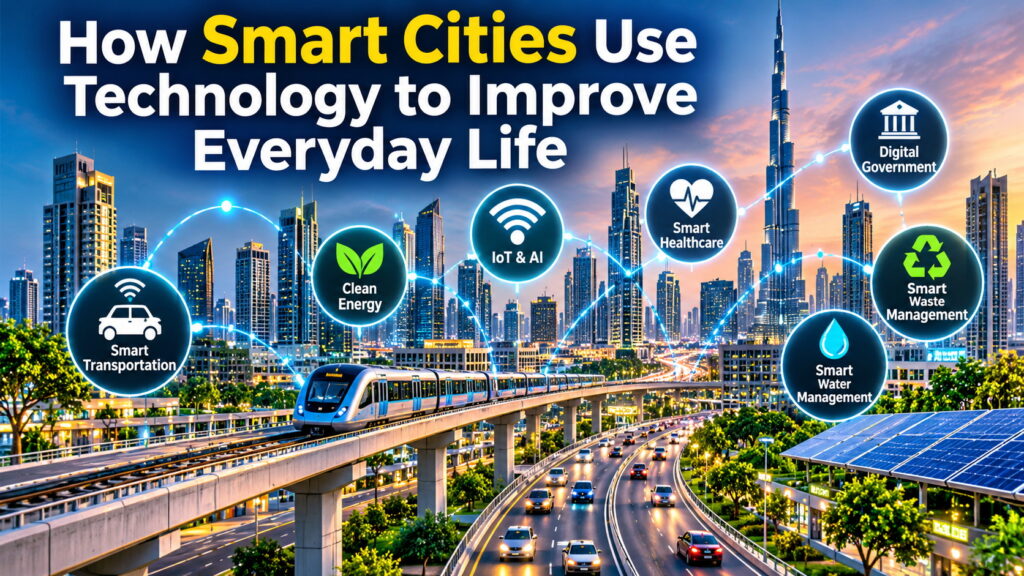


How Smart Cities Use Technology to Improve Everyday Life
Smart cities are transforming urban life by combining artificial intelligence, connected devices, advanced infrastructure and data analytics to create more efficient, sustainable and comfortable environments.
From intelligent traffic management and automated public services to energy-efficient buildings and digital healthcare, smart city technologies are changing how people live, work and travel.
1. What Is a Smart City?


A smart city is an urban environment that uses digital technology, connected infrastructure and intelligent management systems to improve public services, optimize resources and enhance residents’ quality of life.
The main technologies behind smart cities include:
- Artificial Intelligence (AI)
- Internet of Things (IoT)
- 5G and high-speed communication networks
- Cloud computing and data analytics
- Robotics and automation
- Renewable energy systems
- Digital twins and virtual simulations
These technologies help urban authorities understand changing conditions, identify problems and make more informed decisions.
2. Intelligent Transportation and Traffic Management


Traffic congestion is one of the biggest challenges facing modern cities. Smart transportation systems use sensors, cameras, communication networks and artificial intelligence to monitor traffic conditions and improve mobility.
Key Applications
- Adaptive traffic lights that respond to traffic demand.
- Smart parking systems that identify available spaces.
- Real-time bus and train arrival information.
- Connected electric vehicle charging stations.
- Intelligent traffic incident detection.
- Automated public transportation systems.
These solutions can reduce congestion, shorten commuting times, improve road safety and lower transportation-related emissions.
3. Smart Energy and Sustainable Buildings


Smart energy systems use digital monitoring, automation and advanced electricity networks to balance energy production and consumption.
Smart buildings can automatically adjust lighting, air conditioning and ventilation according to occupancy, weather conditions and energy demand.
Smart Energy Technologies
- Intelligent electricity grids.
- Smart electricity meters.
- Solar panels and renewable energy integration.
- Battery energy storage systems.
- Energy-efficient LED streetlights.
- Automated building management systems.
These technologies can lower operating costs, reduce unnecessary electricity consumption and support environmental sustainability.
4. Smart Water Management

Water conservation is particularly important in regions with limited freshwater resources. Smart water networks use connected sensors to monitor consumption, detect leaks and maintain water quality.
- Automated underground pipeline leak detection.
- Real-time water consumption monitoring.
- Intelligent irrigation systems.
- Water quality monitoring.
- Optimized wastewater treatment.
By identifying problems earlier, cities can reduce water losses, improve infrastructure reliability and conserve valuable resources.
5. Smart Waste Management and Recycling
Traditional waste collection often follows fixed schedules regardless of how full individual waste containers are. Smart waste management introduces more flexible and efficient collection systems.
Connected waste bins can notify collection teams when they need emptying, while route optimization software helps reduce unnecessary journeys.
Major Benefits
- Reduced waste collection costs.
- Lower fuel consumption.
- Cleaner public spaces.
- Improved recycling efficiency.
- Better monitoring of waste generation.
6. Digital Government and Public Services

Digital government platforms allow residents to complete everyday transactions using websites and mobile applications without visiting physical government offices.
Examples of Digital Services
- Digital identity and electronic documents.
- Online license and permit applications.
- Electronic payments and government transactions.
- Public maintenance reporting applications.
- Integrated government service platforms.
- Online appointment scheduling.
Digital transformation can reduce paperwork, shorten waiting times and make public services more convenient. Accessible alternatives should remain available for people who cannot easily use digital platforms.
7. Smart Healthcare and Connected Medical Services

Smart healthcare uses connected medical devices, digital platforms and intelligent information systems to improve patient care and healthcare accessibility.
- Remote medical consultations.
- Wearable health monitoring devices.
- Electronic medical records.
- Intelligent hospital management.
- Connected emergency response systems.
- AI-assisted medical analysis.
These innovations can support earlier detection of certain health problems, reduce administrative workloads and improve coordination between healthcare professionals.
8. Public Safety and Emergency Response
Smart cities use connected infrastructure, environmental monitoring and communication systems to support public safety and emergency management.
Key Applications
- Automated fire detection systems.
- Flood and severe weather monitoring.
- Connected emergency service dispatch.
- Digital public warning systems.
- Air quality and environmental monitoring.
- Intelligent infrastructure inspections.
These technologies can help authorities respond more efficiently to emergencies. Strong cybersecurity, privacy safeguards and responsible data governance are essential to their implementation.
9. How Smart City Technology Works
Smart city systems operate through several interconnected layers that transform information into practical improvements.
Sensors, cameras, smart meters and connected devices
5G, fiber-optic networks and IoT communication
Artificial intelligence, cloud computing and data analytics
Transportation, energy, healthcare and public services
Efficiency, sustainability, accessibility and safety
10. Real-World Examples of Smart Cities
Dubai — United Arab Emirates

Dubai has embraced digital transformation through intelligent infrastructure, paperless government services, smart electricity networks and advanced transportation systems.
- Integrated digital government services.
- Smart electricity and water meters.
- Intelligent transportation infrastructure.
- Digital payments and electronic transactions.
- Artificial intelligence initiatives.
Official resource: Digital Dubai
Singapore


Singapore’s Smart Nation initiative integrates digital technologies into public services, urban infrastructure and economic development.
Its smart city approach includes digital public services, intelligent water management, connected transportation and technology-assisted urban planning.
Official resource: Smart Nation Singapore
Barcelona — Spain

Barcelona has introduced connected urban technologies to improve public infrastructure, environmental monitoring and municipal services.
Sensor-based irrigation, digital public services and sustainable urban planning demonstrate how technology can improve established cities.
Official resource: Barcelona City Council
11. Advantages and Challenges of Smart Cities
| Advantages | Challenges |
|---|---|
| Reduced traffic congestion | High implementation costs |
| Improved energy efficiency | Cybersecurity threats |
| Accessible public services | Data privacy concerns |
| Better resource management | Technology dependence |
| Lower environmental impact | Digital inequality |
| Faster emergency response | Infrastructure maintenance |
| Improved urban planning | System integration complexity |
Successful smart city development requires more than advanced technology. It also depends on effective planning, transparent governance, public participation and accessible services.
12. The Future of Smart Cities

Future smart cities are expected to become increasingly connected, automated and environmentally sustainable.
Emerging Smart City Technologies
- Autonomous public transportation.
- AI-powered urban planning.
- Advanced digital twins of urban environments.
- Intelligent renewable energy networks.
- Robotic infrastructure maintenance.
- Next-generation communication networks.
- Predictive infrastructure monitoring.
- Advanced climate adaptation systems.
Digital twins are virtual representations of physical environments. They can help urban planners simulate infrastructure changes, environmental conditions and future developments before implementing them in the real world.
Smart Cities at a Glance
Intelligent decisions and automation
Connected infrastructure and devices
Sustainable power generation
Efficient urban transportation
Convenient government transactions
Virtual city planning and simulations
Frequently Asked Questions
What is the main purpose of a smart city?
The main purpose is to improve residents’ quality of life through efficient public services, sustainable infrastructure and responsible use of digital technology.
How do smart cities use artificial intelligence?
Artificial intelligence can analyze urban data, predict infrastructure problems, optimize traffic flow and support efficient resource management.
Is Dubai a smart city?
Yes. Dubai has introduced numerous smart city initiatives involving digital government services, intelligent utilities, connected transportation and artificial intelligence.
Are smart cities environmentally friendly?
Smart city technologies can reduce energy consumption, water losses, traffic emissions and waste. However, their overall environmental benefits depend on implementation and responsible management.
What are the biggest risks of smart cities?
Major risks include cybersecurity threats, privacy violations, high infrastructure costs, technology dependence and unequal access to digital services.
Conclusion
Smart cities represent a significant evolution in modern urban development. By combining artificial intelligence, connected infrastructure and sustainable engineering, cities can improve public services, conserve natural resources and create more convenient living environments.
The ultimate purpose of a smart city is not simply to introduce advanced technology, but to make everyday life safer, easier, more accessible and more sustainable for everyone.
The cities of tomorrow will be defined not only by their technology, but by how effectively that technology improves human life.
References and Further Reading
- Digital Dubai
- Singapore Smart Nation
- Barcelona City Council
- International Telecommunication Union
- United Nations Human Settlements Programme
Illustrative photography: Unsplash. Images are used to illustrate urban environments and related technologies.