


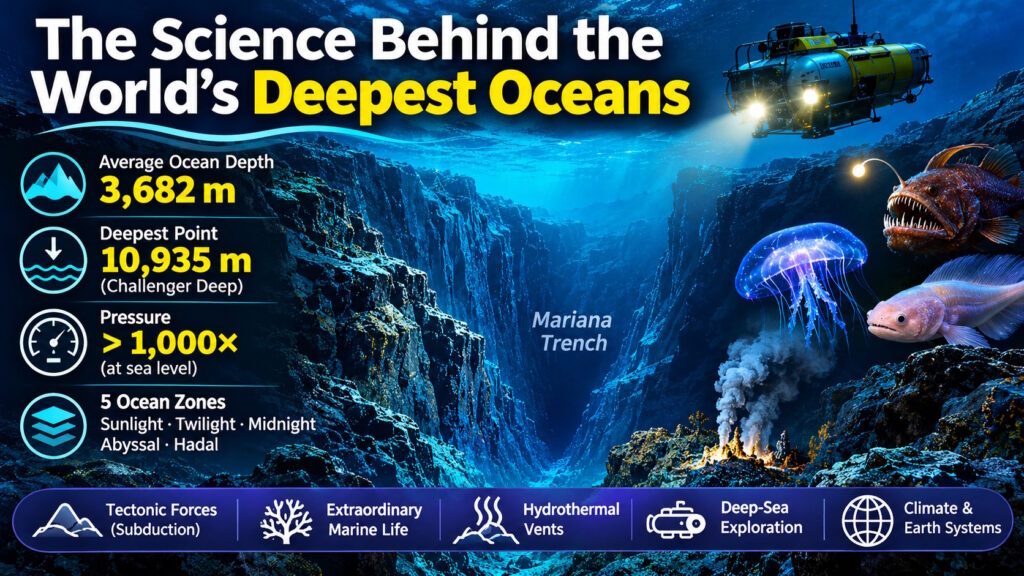
The Science Behind the World’s Deepest Oceans
Discover the incredible science of Earth’s deepest oceans, from the Mariana Trench and crushing underwater pressure to mysterious marine creatures and groundbreaking exploration technology.
More than 70% of Earth’s surface is covered by oceans, yet much of the deep seafloor remains unexplored in detail. Thousands of meters below the waves, scientists encounter extreme pressure, permanent darkness, unusual geological formations, and remarkable organisms adapted to conditions that would be deadly to humans.
The deepest known point, Challenger Deep in the Mariana Trench, reaches approximately 10,935 meters (35,876 feet). This extraordinary depth provides a natural laboratory for studying Earth’s geology, marine biology, ocean chemistry, and the limits of life.
1. How Deep Are the World’s Oceans?
According to NOAA, the global ocean has an estimated average depth of approximately 3,682 meters (12,080 feet). However, the ocean floor is far from flat. It contains underwater mountain ranges, volcanic peaks, broad abyssal plains, and narrow trenches.
The deepest known location is Challenger Deep, situated within the Mariana Trench in the western Pacific Ocean.
- Average global ocean depth: 3,682 meters
- Deepest known point: Challenger Deep
- Approximate maximum depth: 10,935 meters
- Location: Western Pacific Ocean
- Pressure at maximum depth: More than 1,000 times atmospheric pressure at sea level


For perspective, Mount Everest stands approximately 8,849 meters above sea level. If it were placed at Challenger Deep, its summit would still lie more than two kilometers beneath the ocean surface.
2. How Are Deep Ocean Trenches Formed?
Ocean trenches are primarily created through a geological process called subduction.
Subduction occurs when one tectonic plate moves beneath another and gradually descends into Earth’s mantle. This process can create long, narrow depressions along the seafloor.
The Mariana Trench formed where the Pacific Plate moves beneath the Philippine Sea Plate along the Mariana plate boundary.
Why Ocean Trenches Matter
- They reveal how Earth’s tectonic plates move.
- They are associated with powerful earthquakes.
- They help scientists understand volcanic activity and mountain-building processes.
- They influence the movement and recycling of materials through Earth’s interior.
- They contain unique ecosystems adapted to extreme conditions.
3. The Five Major Ocean Depth Zones
Scientists commonly divide the ocean into five broad depth zones based on depth and environmental conditions.
| Ocean Zone | Depth | Main Features |
|---|---|---|
| Sunlight (Epipelagic) | 0–200 m | Sunlight supports photosynthesis. |
| Twilight (Mesopelagic) | 200–1,000 m | Weak sunlight and specialized marine life. |
| Midnight (Bathypelagic) | 1,000–4,000 m | Permanent darkness and high pressure. |
| Abyssal (Abyssopelagic) | 4,000–6,000 m | Cold water and vast deep-ocean environments. |
| Hadal (Hadalpelagic) | Below 6,000 m | Deep trenches and extreme pressure. |
These depth zones represent very different habitats. The deeper the water, the less sunlight is available, while pressure generally increases.
4. Why Is Water Pressure So Extreme?
Water pressure increases by approximately one atmosphere for every 10 meters of seawater depth.
At Challenger Deep, pressure reaches approximately 1,100 times the atmospheric pressure experienced at sea level.
This enormous force creates major engineering challenges. Ordinary diving equipment cannot withstand such conditions, so deep-sea exploration requires specially designed pressure-resistant vehicles and instruments.
Despite these conditions, certain microorganisms and marine animals survive through remarkable biological adaptations.
5. Extraordinary Animals of the Deep Ocean
The deep ocean contains organisms that have adapted to darkness, cold temperatures, high pressure, and limited food supplies.


Deep-Sea Snailfish
Snailfish include species capable of living at remarkable ocean depths. Some specialized species inhabit hadal trenches, where their cellular chemistry helps them tolerate extremely high pressure.
Amphipods
These small crustaceans play important roles in deep-ocean food webs. Some are scavengers that feed on organic material reaching the seafloor.
Sea Cucumbers
Many deep-sea sea cucumbers obtain food from sediments on the ocean floor. Their feeding activities help recycle organic material in abyssal habitats.
Bioluminescent Animals
Some deep-sea organisms produce light through chemical reactions. This phenomenon, known as bioluminescence, can help attract prey, communicate, or avoid predators.
Not all deep-sea creatures produce light. Bioluminescence is especially widespread in the ocean’s middle depths.
6. Hydrothermal Vents: Life Without Sunlight
Among the ocean’s most remarkable discoveries are hydrothermal vents, where hot, mineral-rich fluids emerge from the seafloor.
These environments are often associated with tectonic activity and underwater volcanism.


Unlike ecosystems powered by sunlight, hydrothermal vent communities can rely on chemosynthesis.
Microorganisms use chemical energy from substances such as hydrogen sulfide to produce organic compounds that support food webs.
These microbial communities can support shrimp, crabs, snails, worms, and other specialized organisms.
Hydrothermal vents demonstrate that complex ecosystems can exist without direct sunlight, an important discovery for scientists investigating the possibility of life elsewhere in the Solar System.
7. How Scientists Explore the Deepest Oceans
Exploring the deep ocean requires advanced technology capable of operating under immense pressure, low temperatures, and complete darkness.
Remotely Operated Vehicles (ROVs)
ROVs are underwater robots controlled by operators aboard research vessels. They can carry cameras, lighting, sampling equipment, and robotic arms.
Autonomous Underwater Vehicles (AUVs)
AUVs can perform programmed missions without continuous direct control, making them valuable for seafloor surveys and scientific data collection.
Human-Occupied Submersibles
Specialized submersibles protect their occupants inside pressure-resistant compartments, allowing researchers to visit selected deep-ocean environments.
Multibeam Sonar
Research ships use sound waves to measure seafloor depth and build detailed bathymetric maps. This technology reveals underwater valleys, mountains, ridges, and trenches.
8. The Deep Ocean and Earth’s Climate
The deep ocean plays a major role in Earth’s climate system.
Ocean circulation redistributes heat, dissolved gases, and nutrients across the planet. Cold, dense waters can sink at high latitudes and move through deep ocean basins over long periods.
The ocean also stores substantial amounts of heat and carbon, helping regulate the global climate. However, changes in warming, oxygen availability, and ocean chemistry can affect deep marine habitats.
9. Why Deep-Ocean Research Is Important
Understanding the deepest parts of the ocean contributes to several important scientific fields.
- Geology: Investigating plate tectonics, earthquakes, and volcanic processes.
- Marine biology: Discovering new species and understanding extreme adaptations.
- Climate science: Studying carbon storage, ocean circulation, and climate change.
- Engineering: Developing pressure-resistant materials, sensors, and autonomous robotic systems.
- Astrobiology: Understanding whether life could exist in environments beneath icy worlds such as Europa or Enceladus.
- Conservation: Identifying vulnerable habitats and evaluating human impacts.
10. Fascinating Facts About the Deepest Oceans
- The Mariana Trench contains Earth’s deepest known ocean location.
- Challenger Deep reaches approximately 10.9 kilometers beneath the surface.
- Sunlight does not reach the deepest ocean zones.
- Water temperatures in many deep-ocean habitats remain only a few degrees above freezing.
- Pressure-resistant organisms inhabit environments that ordinary marine animals cannot tolerate.
- Hydrothermal vents can support ecosystems powered by chemical energy rather than sunlight.
- Much of the ocean floor has not yet been mapped in high resolution.
Conclusion: Earth’s Last Great Frontier
The world’s deepest oceans remain among Earth’s most extraordinary scientific frontiers. Their crushing pressure, complex geology, unusual biological communities, and largely unexplored landscapes continue to challenge our understanding of the natural world.
As advanced underwater robots, sonar systems, and research submersibles improve, scientists gain new opportunities to investigate these remote environments.
Every discovery brings us closer to understanding Earth’s oceans, protecting their ecosystems, and discovering how life can survive under the most extreme conditions.