


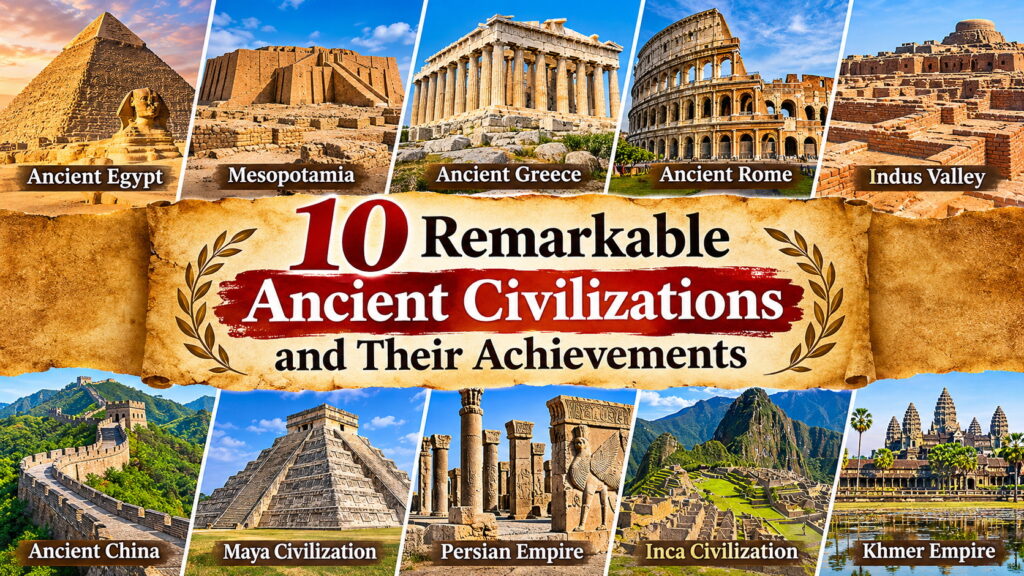
Long before modern technology, ancient civilizations developed extraordinary systems of government, engineering, science, architecture, and communication. Their achievements helped shape the world we live in today.
From Egypt’s towering pyramids to the sophisticated astronomical calculations of the Maya, these societies demonstrated remarkable creativity, intelligence, and organizational skill.
Here are ten fascinating ancient civilizations and the achievements that made them historically significant.
1. Ancient Egypt – Masters of Monumental Architecture


Location: Northeastern Africa, along the Nile River
Period: Approximately 3100–30 BCE
Ancient Egypt developed one of history’s most enduring civilizations. Its achievements in architecture, mathematics, medicine, and agriculture continue to fascinate researchers.
The Great Pyramid of Giza, constructed during the reign of Pharaoh Khufu, remains an extraordinary example of ancient engineering. Thousands of workers organized the transportation and placement of enormous stone blocks.
Major Achievements
- Construction of pyramids and monumental temples.
- Development of hieroglyphic writing.
- Use of papyrus for written documents.
- Advances in medical knowledge and treatment.
- Agricultural systems supported by the Nile River.
Lasting legacy: Egyptian monuments and surviving writings provide invaluable evidence of ancient engineering, religion, and everyday life.
2. Mesopotamia – The Birthplace of Early Cities


Location: Modern Iraq and surrounding regions
Period: From approximately 3500 BCE onward
Mesopotamia, situated between the Tigris and Euphrates rivers, was home to influential societies including the Sumerians, Akkadians, Babylonians, and Assyrians.
Its inhabitants developed some of the earliest known cities and writing systems. Urban centers such as Uruk became important places of trade, administration, and religious activity.
Major Achievements
- Development of cuneiform writing.
- Innovations in wheeled transportation.
- Construction of irrigation canals.
- Development of sophisticated mathematics.
- Creation of written legal codes.
Mesopotamian mathematicians used a base-60 numerical system. Its influence remains visible in our division of hours into 60 minutes and circles into 360 degrees.
Lasting legacy: Writing, urban administration, and mathematical methods became foundations of complex societies.
3. Ancient Greece – Philosophy, Science and Democracy


Location: Greece and the Mediterranean
Period: Approximately 800–146 BCE for the Archaic through Hellenistic eras
Ancient Greece became a major center of intellectual, artistic, and political innovation.
Philosophers such as Socrates, Plato, and Aristotle explored fundamental questions about ethics, knowledge, and government. Greek thinkers also advanced mathematics, medicine, astronomy, and historical writing.
Major Achievements
- Development of direct democracy in ancient Athens.
- Important philosophical traditions.
- Contributions to mathematics and scientific reasoning.
- Development of classical theater and drama.
- Establishment of the ancient Olympic Games.
Lasting legacy: Greek ideas continue to influence political theory, philosophy, education, science, and the arts.
4. Ancient Rome – Engineering and Administration


Location: Italy, Europe, North Africa and Western Asia
Period: Traditionally 753 BCE–476 CE for ancient Rome and the Western Roman Empire
Rome evolved from a small settlement into an extensive imperial power that connected territories across Europe, North Africa, and Western Asia.
Roman engineers constructed roads, bridges, aqueducts, and public buildings on an impressive scale. Their infrastructure supported trade, communication, military movement, and urban development.
Major Achievements
- Construction of extensive road networks.
- Development of aqueduct systems.
- Advanced concrete construction techniques.
- Monumental public architecture.
- Influential legal and administrative institutions.
The Colosseum is a famous example of Roman architectural design, combining arches, vaults, and carefully planned circulation routes for large crowds.
Lasting legacy: Roman law, engineering, languages, and urban planning influenced numerous later societies.
5. Indus Valley Civilization – Pioneers of Urban Planning


Location: Modern Pakistan and northwestern India
Period: Mature urban phase approximately 2600–1900 BCE
The Indus Valley Civilization, also known as the Harappan Civilization, developed remarkably organized urban settlements.
Cities such as Mohenjo-daro and Harappa featured carefully arranged streets, standardized brick construction, wells, and drainage facilities.
Major Achievements
- Carefully planned urban settlements.
- Sophisticated drainage and sanitation systems.
- Advanced water management.
- Standardized weights and measures.
- Long-distance trade networks.
At Mohenjo-daro, many buildings included bathing facilities connected to drainage systems. These features demonstrate impressive attention to public infrastructure and urban organization.
The Indus script has not yet been deciphered, leaving many questions about the civilization’s political organization and language unanswered.
Lasting legacy: Its archaeological remains demonstrate how advanced urban infrastructure existed thousands of years before modern cities.
6. Ancient China – Innovation Across Dynasties


Location: East Asia
Period: Early dynastic civilization from the second millennium BCE onward
Ancient China developed a rich tradition of innovation in agriculture, administration, metallurgy, philosophy, and technology.
During the Shang and Zhou periods, bronze craftsmanship and early Chinese writing flourished. Later dynasties introduced major improvements in infrastructure, manufacturing, and governmental organization.
Major Achievements
- Advanced bronze casting and metalworking.
- Silk production and textile craftsmanship.
- Development of papermaking during the Han dynasty.
- Sophisticated governmental administration.
- Construction of major defensive fortifications.
The Great Wall represents defensive construction undertaken across many centuries. Large surviving sections were built or rebuilt during the much later Ming dynasty.
Lasting legacy: Chinese technologies, philosophical traditions, and institutions profoundly influenced East Asia and the wider world.
7. Maya Civilization – Astronomy and Mathematics


Location: Mexico and Central America
Period: Formative societies from around 2000 BCE; Classic period approximately 250–900 CE
The ancient Maya developed sophisticated mathematical, astronomical, architectural, and writing systems.
Maya astronomers studied the movements of the Sun, Moon, and planets, using their observations to develop complex calendar systems.
Major Achievements
- A positional number system incorporating zero.
- Detailed astronomical calculations.
- Interconnected calendar systems.
- Hieroglyphic writing.
- Construction of monumental temples and cities.
The Maya used several calendar cycles, including a 365-day solar calendar and a 260-day ritual calendar. Their surviving inscriptions provide important historical and astronomical information.
Lasting legacy: Maya mathematics and astronomical records remain important subjects of research. Maya communities and cultural traditions continue to thrive today.
8. Persian Empire – Administration and Infrastructure


Location: Centered in modern Iran
Period: Achaemenid Empire, approximately 550–330 BCE
The Achaemenid Persian Empire governed a vast territory inhabited by diverse peoples, languages, and cultures.
Its rulers developed administrative structures that helped coordinate communication, taxation, and regional government across great distances.
Major Achievements
- Development of provincial administrative systems.
- Expansion of the Royal Road network.
- Organized imperial communication services.
- Monumental architectural projects.
- Management of a large multicultural empire.
Under rulers such as Cyrus the Great and Darius I, the empire established institutions that helped manage its enormous territory.
Persepolis, one of the empire’s ceremonial centers, illustrates the artistic and architectural achievements of Achaemenid Persia.
Lasting legacy: Persian administrative and communication practices influenced subsequent empires.
9. Inca Civilization – Engineering in the Andes


Location: Andean South America
Period: Imperial expansion mainly during the 15th and early 16th centuries CE
The Inca created one of the largest empires in pre-Columbian America, overcoming extraordinary geographical challenges.
Their engineers constructed roads, bridges, agricultural terraces, and mountain settlements across difficult Andean terrain.
Major Achievements
- Construction of extensive Andean road networks.
- Precisely fitted stone masonry.
- Terrace agriculture on steep mountain slopes.
- Sophisticated water-management systems.
- Quipu recordkeeping using knotted cords.
Machu Picchu is among the most recognizable examples of Inca architectural and engineering skill. Its carefully constructed terraces and stone buildings reflect sophisticated knowledge of mountainous environments.
Lasting legacy: Inca infrastructure and agricultural techniques demonstrate remarkable adaptation to high-altitude landscapes.
10. Khmer Empire – Hydraulic Engineering and Temple Cities


Location: Cambodia and surrounding Southeast Asia
Period: Approximately 802–1431 CE, as traditionally dated
The Khmer Empire developed one of Southeast Asia’s most impressive premodern urban and architectural traditions.
Its capital region at Angkor included monumental religious complexes, reservoirs, canals, and carefully organized settlements.
Major Achievements
- Construction of the enormous Angkor Wat complex.
- Large-scale reservoirs and water infrastructure.
- Elaborate stone-carving traditions.
- Extensive religious and ceremonial architecture.
- Sophisticated urban development.
Angkor Wat, built in the early 12th century, is among the world’s largest religious monuments. Its architectural design and decorative carvings reflect the extraordinary capabilities of Khmer artisans and builders.
Lasting legacy: Khmer architecture and artistic traditions remain central to Cambodia’s cultural heritage.
Comparing the Achievements of Ancient Civilizations
| Civilization | Major Achievements |
|---|---|
| Ancient Egypt | Pyramids, hieroglyphics, medicine |
| Mesopotamia | Early writing, cities, mathematics |
| Ancient Greece | Philosophy, democracy, science |
| Ancient Rome | Roads, aqueducts, legal traditions |
| Indus Valley | Urban planning and sanitation |
| Ancient China | Papermaking, silk, metallurgy |
| Maya | Astronomy, mathematics, calendars |
| Persian Empire | Administration and communication networks |
| Inca | Mountain engineering, roads and terraces |
| Khmer Empire | Temples, reservoirs and urban infrastructure |
Why Ancient Civilizations Still Matter
These civilizations were separated by geography, language, and historical circumstances, yet many confronted similar challenges: producing food, managing water, organizing communities, recording information, and building durable infrastructure.
Their solutions helped shape human history. Modern architecture, public administration, mathematics, transportation, and scientific observation all reflect developments accumulated across many cultures and centuries.
Ancient societies also did not develop entirely in isolation. Trade, migration, cultural exchange, and the sharing of knowledge contributed to innovations throughout the world.
Conclusion
The achievements of ancient civilizations remind us that innovation is not exclusively modern. Thousands of years ago, people were already solving difficult engineering problems, exploring mathematical ideas, establishing complex institutions, and creating monumental works of art.
From Mesopotamian writing and Egyptian architecture to Maya astronomy and Inca engineering, their legacies remain visible in our world today.
Studying these civilizations offers more than a glimpse into the distant past. It reveals the extraordinary creativity, adaptability, and ambition of human societies.