


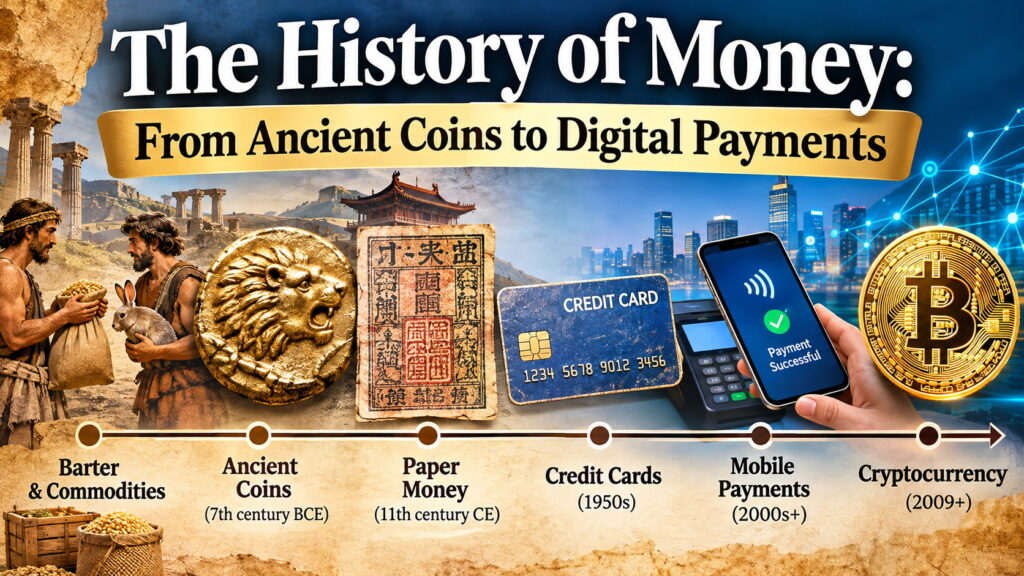
The History of Money: From Ancient Coins to Digital Payments
Money is one of the most important inventions in human history. It has shaped civilizations, encouraged international trade, supported the growth of empires, and transformed how people buy and sell goods. From ancient shells and metal coins to paper banknotes, credit cards, and digital currencies, the evolution of money tells an extraordinary story of human innovation.
Today, billions of transactions can take place electronically without a single physical coin changing hands. But how did humanity reach this point, and what might money look like in the future?
1. Before Money: Barter, Commodities, and Early Trade
Before standardized coins existed, ancient societies used a variety of methods to exchange goods and settle obligations. People could trade food, livestock, tools, textiles, and other valuable products directly. This is commonly called barter.
Barter had limitations. A farmer wanting pottery needed to find someone who both owned pottery and wanted what the farmer could offer. Economists call this the double coincidence of wants.
However, early economies were not exclusively based on barter. Ancient Mesopotamian societies also developed sophisticated accounting, credit, and debt systems. Grain and silver could serve as units for measuring value long before minted coins appeared.
Different cultures used commodities such as cattle, shells, precious metals, and other widely accepted objects as forms of money.


2. The First Metal Coins: Ancient Lydia
One of the greatest milestones in monetary history occurred around the seventh century BCE, when standardized metal coins emerged in Lydia and nearby regions of Anatolia, in present-day Turkey.
Some early Lydian coins were made from electrum, a naturally occurring alloy of gold and silver. They carried stamped designs that helped identify their issuing authority.
Under King Croesus in the sixth century BCE, Lydia developed influential gold and silver coinage. Coins offered a more convenient way to make payments because their weights and official designs helped establish recognizable standards.


Coinage subsequently spread throughout the ancient Mediterranean and surrounding regions. Greek city-states, Persian rulers, and Roman authorities all developed systems of coins that supported commerce, taxation, and government spending.
3. Money and the Growth of Ancient Empires
As civilizations expanded, money became increasingly important for trade across long distances. Greek silver coins circulated beyond their places of origin, while Roman coins helped connect markets throughout the empire.
In China, bronze coins often featured round shapes with square central holes. Across Islamic trading networks, gold dinars and silver dirhams became influential monetary instruments, supporting commerce between the Middle East, Africa, Asia, and Europe.
Despite their usefulness, ancient coins were not without problems. Governments sometimes reduced precious-metal content, while merchants had to evaluate foreign currencies, weights, and exchange rates.
4. The Invention of Paper Money in China
Metal coins were durable, but carrying large quantities could be inconvenient and expensive. China became a pioneer in developing alternatives.
During the Tang dynasty, merchants used arrangements that allowed funds to be transferred without physically transporting all their coins. By the Northern Song dynasty, printed notes called jiaozi had emerged as some of the world’s earliest paper banknotes.
Paper money made large transactions easier and reduced dependence on transporting heavy metal currency. However, it also created a challenge: people needed confidence that the notes would retain their purchasing power.


Paper currency continued evolving across Chinese dynasties and eventually became important in monetary systems around the world.
5. The Rise of Banking and Modern Currency
The growth of international commerce encouraged the development of banks, merchant finance, and more advanced payment arrangements.
Medieval merchants used bills of exchange to settle obligations between trading centers without transporting large quantities of precious metals. Banking institutions gradually expanded services such as deposits, loans, and transfers.
In Europe and elsewhere, banknotes eventually became an important part of everyday economic life. Central banks also developed increasingly important roles in issuing currency, managing monetary conditions, and supporting financial stability.
For extended periods, some monetary systems linked their currencies to gold or silver. During the twentieth century, major economies moved away from fixed gold-convertibility arrangements.
Most modern national currencies are now fiat currencies. Their value is not defined by a promise to exchange them for a fixed quantity of precious metal. Instead, their usefulness depends on institutional credibility, economic conditions, government policies, and widespread public acceptance.


6. Credit Cards and the Electronic Banking Revolution
The twentieth century brought another major transformation: money increasingly moved through electronic systems instead of physical cash.
Multipurpose charge cards became prominent in the 1950s, followed by expanding bank credit-card systems and international payment networks.
Automated teller machines gave customers greater access to their bank accounts, while electronic funds transfers enabled payments to move between financial institutions.
Debit cards allowed consumers to spend directly from their deposit accounts. Credit cards enabled purchases financed through borrowing, subject to repayment terms.
These developments changed the relationship between money and payment instruments. The value being transferred could exist as a bank-account balance, while a plastic card or electronic message simply provided a way to initiate the transaction.
7. Internet Banking and Mobile Payments
The rapid expansion of the internet during the 1990s and 2000s introduced new ways to manage money. Customers increasingly gained the ability to check account balances, pay bills, and transfer funds from computers.
Smartphones accelerated this transformation. Today, consumers can use contactless cards, mobile wallets, QR codes, and instant bank transfers to make payments in shops or online.
Modern services such as Apple Pay and Google Wallet can securely transmit payment credentials through compatible devices and merchant terminals.


Instant payment systems are also changing how money moves. Instead of waiting for traditional settlement processes to finish, individuals and businesses in many markets can transfer funds within seconds, depending on the payment network and participating institutions.
8. Bitcoin, Blockchain, and Cryptocurrencies
In 2008, a person or group using the pseudonym Satoshi Nakamoto published a proposal for Bitcoin. The network began operating in 2009.
Bitcoin introduced a decentralized electronic payment system that uses a distributed transaction ledger rather than relying on a single institution to maintain its records.
The underlying blockchain technology connects transaction records through cryptographic methods, helping participants agree on the transaction history according to the network’s rules.
Bitcoin inspired the development of many other cryptocurrencies and blockchain-based applications. Some projects explore new ways to transfer assets, execute agreements, or provide financial services.
However, cryptocurrencies also face significant challenges. Their prices can be highly volatile, security failures and fraud can lead to losses, and their legal treatment differs across jurisdictions.
Cryptocurrencies therefore represent an important development in the history of digital value, but they are not interchangeable with ordinary bank deposits or government-issued currency.
9. Central Bank Digital Currencies and the Future of Money
Central banks around the world have researched digital forms of sovereign money, commonly called central bank digital currencies, or CBDCs.
A CBDC would be a digital form of central bank money. Its design could differ significantly from privately issued cryptocurrencies, stablecoins, or the deposits people already hold at commercial banks.
Other important financial innovations include faster international transfers, improved fraud detection, digital identity systems, and greater integration between payment services.
Although digital transactions are becoming increasingly common, the future of money does not necessarily mean the complete disappearance of cash. Physical currency can remain important for accessibility, resilience, privacy, and people who have limited access to digital financial services.
10. Timeline: The Evolution of Money
| Period | Major Development |
|---|---|
| Ancient civilizations | Commodity money, accounting systems, and credit arrangements |
| 7th century BCE | Early standardized metal coins in Lydia and surrounding regions |
| 6th century BCE | Influential gold and silver coinage under King Croesus |
| 11th century CE | Early paper banknotes in Song-dynasty China |
| Medieval and early modern periods | Expansion of banking and international bills of exchange |
| 19th–20th centuries | Development of modern monetary and central banking systems |
| 1950s | Growing adoption of multipurpose payment cards |
| Late 20th century | Electronic banking, ATMs, and computerized payment systems |
| 1990s–2000s | Internet banking and online payments expand |
| 2009 | Bitcoin network launches |
| 2010s–2020s | Growth of mobile wallets, instant payments, and digital currency initiatives |
Conclusion: Money Is a Story of Trust and Innovation
The history of money reflects humanity’s continuous search for easier, safer, and more efficient ways to exchange value.
Ancient coins provided recognizable standards. Paper banknotes made large payments easier to transport. Banking and electronic systems allowed financial transactions to move beyond physical objects. Digital payment networks now enable money to cross great distances almost instantly.
Despite these changes, one fundamental principle remains: money functions because people trust and accept it as a means of payment and a measure of value.
As technology continues to advance, the forms of money may evolve further, but the need for reliable systems of exchange will remain central to economic life.