


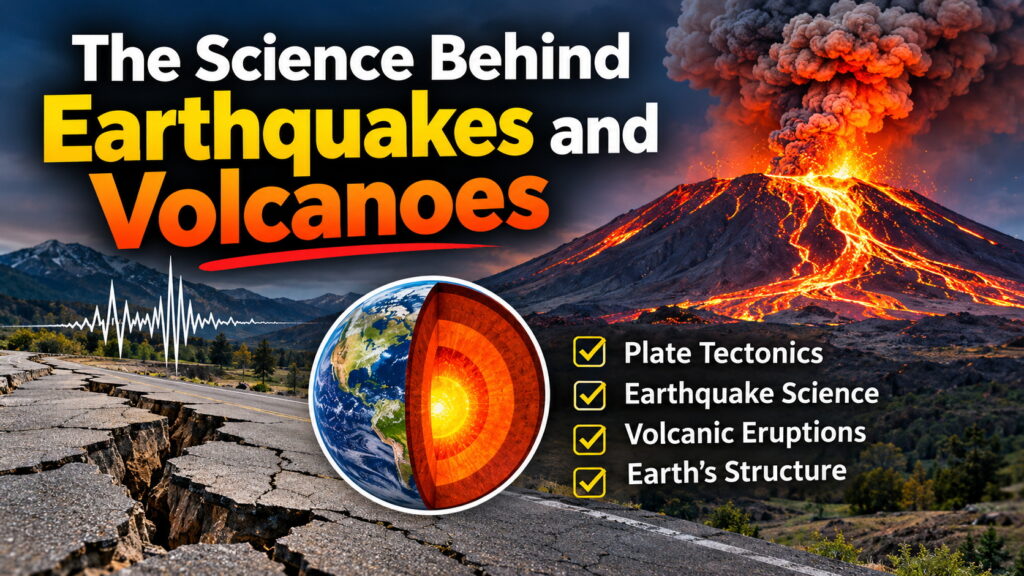
The Science Behind Earthquakes and Volcanoes
Earthquakes and volcanoes are among the most powerful natural forces on our planet. They can destroy buildings, reshape landscapes, create mountains, and even form new islands. Although they appear to be different geological events, both are closely connected to the movements and processes taking place inside Earth.
Understanding the science behind earthquakes and volcanoes reveals how our planet works, why certain regions experience frequent geological activity, and how scientists monitor these natural hazards to protect lives.


1. Understanding Earth’s Internal Structure
To understand earthquakes and volcanoes, we must first explore what lies beneath Earth’s surface.
Our planet is composed of several layers, each with different physical and chemical properties.


The Crust
The crust is Earth’s outermost solid layer. It is relatively thin compared with the rest of the planet and includes both continental and oceanic crust.
The Mantle
Beneath the crust lies the mantle, a thick region of predominantly solid rock. Although solid, mantle material can deform and flow extremely slowly over geological timescales.
The Outer Core
The outer core consists mainly of liquid iron and nickel. Movement within this electrically conducting material helps generate Earth’s magnetic field.
The Inner Core
The inner core is a solid region composed primarily of iron, kept solid by enormous pressure despite its extremely high temperature.
The rigid crust and uppermost mantle together form the lithosphere, which is broken into large tectonic plates.
2. Plate Tectonics: Why Earth’s Surface Moves
Earth’s lithosphere is divided into tectonic plates that move slowly relative to one another, generally by a few centimeters per year.
These movements are driven by a combination of gravitational forces and processes associated with Earth’s internal heat.
Over millions of years, plate tectonics can form oceans, build mountain ranges, and rearrange continents.


Convergent Boundaries
Convergent boundaries occur when two tectonic plates move toward each other. In some cases, one plate sinks beneath another through a process known as subduction.
Subduction zones can produce powerful earthquakes and volcanic activity. The Andes mountain range and Japan’s volcanic regions are associated with convergent plate boundaries.
Divergent Boundaries
Divergent boundaries occur when tectonic plates move apart. As the mantle rises beneath these regions, reduced pressure can cause partial melting, generating magma.
This process creates new oceanic crust along mid-ocean ridges and contributes to volcanic activity in places such as Iceland.
Transform Boundaries
At transform boundaries, tectonic plates slide horizontally past each other. Their movement can become temporarily locked by friction, allowing stress to accumulate.
When the fault finally slips, the sudden release of energy generates an earthquake. California’s San Andreas Fault is a well-known example.
3. What Causes Earthquakes?
An earthquake occurs when rocks suddenly move along a fault, releasing accumulated elastic energy into the surrounding Earth.
This energy travels outward as seismic waves, producing the shaking felt at the surface.
The Four Main Stages of an Earthquake
- Stress accumulation: Tectonic forces gradually deform rocks around a fault.
- Fault rupture: When the forces overcome resistance to movement, the fault slips.
- Energy release: Seismic waves travel through the Earth’s interior and along its surface.
- Ground shaking: Seismic waves cause vibrations that may damage buildings, roads, and infrastructure.
The underground point where earthquake rupture begins is called the hypocenter, or focus. The point directly above it on Earth’s surface is the epicenter.
Types of Seismic Waves
- P waves: The fastest seismic waves, which compress and expand the material through which they travel.
- S waves: Slower waves that move particles perpendicular to the direction of propagation and cannot travel through liquids.
- Surface waves: Waves that travel along Earth’s surface and can cause significant ground movement.
4. How Are Earthquakes Measured?
Scientists use instruments called seismometers to detect and measure ground movement.
Modern earthquake magnitude is commonly reported using the moment magnitude scale (Mw), which is based on the physical size and movement of the earthquake rupture.
An increase of one magnitude unit represents approximately 32 times more energy released.
However, magnitude should not be confused with intensity. Magnitude describes the overall size of an earthquake, while intensity describes the strength of shaking and its effects at a particular location.
Earthquake damage depends on several factors, including depth, distance from the rupture, ground conditions, construction quality, and duration of shaking.
5. How Do Volcanoes Form?
Volcanoes form when molten rock, known as magma, rises through Earth’s crust and reaches the surface.
Magma can originate through decompression melting, the introduction of water into hot mantle rock, or the transfer of heat into surrounding rocks.
When magma reaches Earth’s surface, it is called lava.
Volcanic eruptions may also release gases, ash, and fragments of solid rock.


What Happens During a Volcanic Eruption?
- Magma forms beneath Earth’s surface.
- Buoyant magma rises through cracks and pathways in surrounding rock.
- Pressure changes allow dissolved volcanic gases to expand.
- Magma, gases, and fragmented rock may erupt through volcanic openings.
- Lava and volcanic deposits accumulate, potentially building or reshaping the volcano.
Not every eruption is explosive. Some volcanoes produce relatively gentle lava flows, while others release enormous columns of ash and gas.
6. Different Types of Volcanoes
Shield Volcanoes
Shield volcanoes have broad, gently sloping profiles created largely by repeated flows of relatively fluid lava. Mauna Loa in Hawaii is a famous example.
Stratovolcanoes
Stratovolcanoes, also called composite volcanoes, are often steep-sided mountains built from alternating volcanic deposits and lava flows. Mount Fuji in Japan is one example.
Cinder Cones
Cinder cones are generally smaller volcanoes formed by the accumulation of volcanic fragments around an erupting vent.
Lava Domes
Lava domes develop when highly viscous magma accumulates close to a volcanic opening rather than flowing far away.
7. Why Are Some Volcanic Eruptions So Explosive?
The explosiveness of volcanic eruptions depends on several factors, especially magma viscosity, dissolved gas content, temperature, and chemical composition.
Fluid basaltic magma often allows gases to escape comparatively easily, although it can still produce spectacular lava fountains.
More viscous magma may trap expanding gases. When pressure is released, the magma can fragment violently, generating explosive eruptions.
Such eruptions may produce dangerous pyroclastic flows, fast-moving mixtures of hot gas, ash, and volcanic fragments that can travel down volcanic slopes.
8. The Pacific Ring of Fire
The Pacific Ring of Fire is a broad zone surrounding much of the Pacific Ocean where frequent earthquakes and numerous volcanoes occur.


Countries and regions associated with the Ring of Fire include Japan, Indonesia, New Zealand, the Philippines, Alaska, and parts of the western Americas.
Much of this activity is related to subduction zones, where one tectonic plate descends beneath another.
Some of the world’s most powerful earthquakes occur at these boundaries. When large offshore earthquakes suddenly displace the seafloor, they can generate tsunamis.
9. Can Earthquakes Trigger Volcanic Eruptions?
Earthquakes and volcanoes are closely related to tectonic activity, but one does not automatically cause the other.
Moving magma can produce earthquakes as it fractures rock or changes pressure within volcanic systems.
Large tectonic earthquakes may sometimes influence nearby volcanic systems by changing stresses in the crust. However, the relationship is complex, and most earthquakes do not cause volcanic eruptions.
Scientists study these interactions using seismic monitoring, satellite observations, and measurements of ground deformation.
10. Can Scientists Predict Earthquakes and Volcanic Eruptions?
Scientists can identify regions with elevated earthquake hazards, but they cannot reliably predict the precise date, location, and magnitude of an individual earthquake.
Earthquake early-warning systems work differently from prediction. They detect an earthquake after it begins and may provide seconds of warning before strong shaking reaches locations farther from the rupture.
Volcanoes sometimes offer more recognizable signs of unrest.
These warning signs can include:
- Increasing numbers of small earthquakes.
- Changes in volcanic gas emissions.
- Ground swelling or deformation.
- Changes in temperature and hydrothermal activity.
- Evidence of magma movement beneath the volcano.
Even with modern monitoring equipment, accurately forecasting the timing, size, and behavior of an eruption remains challenging.
11. How Do Earthquakes and Volcanoes Affect Human Life?
Earthquakes can cause building collapse, landslides, liquefaction, disruption of transportation networks, and tsunamis.
Volcanic eruptions can create hazards from lava flows, ashfall, toxic gases, pyroclastic flows, and volcanic mudflows known as lahars.
Nevertheless, geological processes also provide important natural benefits.
- Volcanic activity can create new land and islands.
- Weathered volcanic materials may contribute to fertile soils.
- Geothermal systems can provide renewable energy.
- Plate tectonics helps build mountain ranges and ocean basins.
- Volcanic regions may contain valuable mineral deposits.
These processes have helped shape Earth’s continents, landscapes, and ecosystems over geological time.
12. How Can Communities Reduce Geological Risks?
Although earthquakes and volcanoes cannot be prevented, their impacts can be reduced through scientific research and effective preparedness.
Important measures include:
- Building and retrofitting structures according to seismic safety standards.
- Monitoring earthquake and volcanic activity.
- Creating hazard maps and evacuation plans.
- Educating communities about emergency procedures.
- Developing reliable public warning and communication systems.
- Avoiding high-risk construction areas where possible.
Combining engineering, scientific monitoring, land-use planning, and public education can significantly reduce the dangers associated with geological hazards.
Conclusion: A Planet That Never Stops Changing
Earthquakes and volcanoes demonstrate that Earth is constantly evolving. Beneath its apparently stable surface, tectonic plates continue moving, rocks deform under enormous pressure, and magma rises through the crust.
These processes have shaped our world for billions of years and will continue to transform its landscapes far into the future.
By studying the science behind earthquakes and volcanoes, researchers gain a better understanding of Earth’s interior while developing technologies and strategies that help societies prepare for natural hazards.