


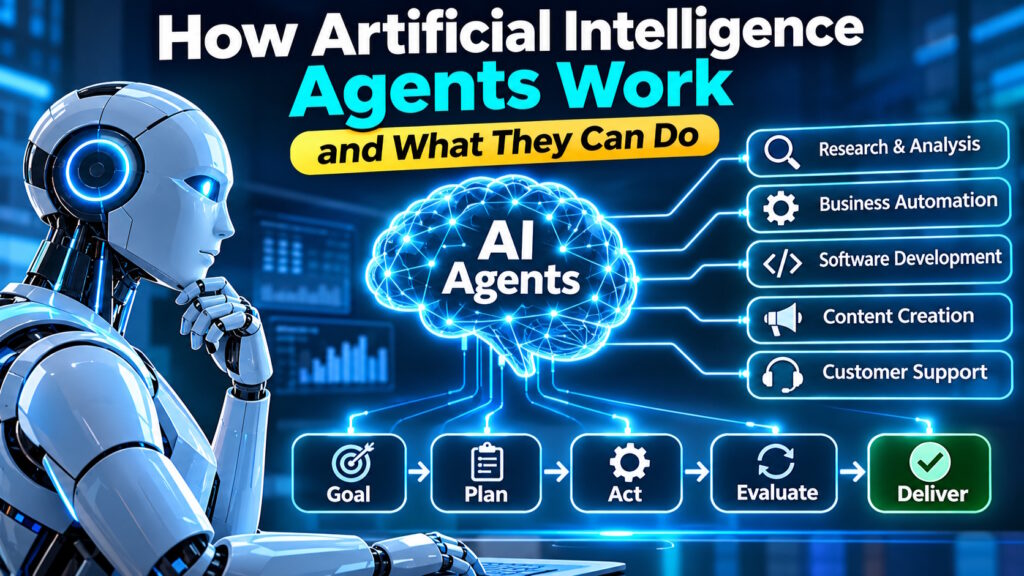
How Artificial Intelligence Agents Work and What They Can Do
Artificial intelligence is evolving from systems that simply answer questions into intelligent agents capable of planning, using tools, analyzing information, and completing complex tasks.


Artificial intelligence agents, commonly called AI agents, represent a significant advancement in automation. Unlike traditional chatbots, AI agents can pursue goals through multiple coordinated actions.
From researching complex topics and creating content to assisting with software development and managing business processes, these intelligent systems are transforming the relationship between people and technology.
1. What Is an Artificial Intelligence Agent?
An AI agent is a software system that uses artificial intelligence to understand objectives, plan activities, interact with authorized tools, and evaluate results.
For example, a chatbot can explain how to prepare a financial report. An AI agent connected to suitable business systems could retrieve relevant records, analyze figures, generate charts, prepare the report, and submit it for approval.
The Main Components of an AI Agent
- AI Model: Processes instructions, interprets information, and determines next actions.
- Tools: Enable interaction with websites, applications, databases, and external services.
- Memory and Context: Help retain relevant information during a workflow and, when configured, across tasks.
- Instructions: Define goals, responsibilities, restrictions, and expected behavior.
- Guardrails: Establish security controls, permissions, and approval requirements.
2. How Do AI Agents Work?
Many AI agents operate through a continuous sequence of planning, action, observation, and evaluation. This process is commonly known as an agent loop.
HOW AN AI AGENT WORKS
Understand the user’s objective
↓
Determine steps and tools
↓
Search, analyze, calculate, or update information
↓
Check accuracy and adjust the approach
↓
Complete the task or request approval
Depending on the task, the agent may repeat several stages until it achieves its goal or reaches a defined stopping condition.
3. What Can Artificial Intelligence Agents Do?
Research and Data Analysis
AI agents can gather information from multiple sources, compare findings, examine datasets, and prepare structured research reports. Applications include market analysis, competitor research, technical investigations, and business intelligence.
Business Process Automation
AI agents can assist with invoice processing, customer inquiry classification, report preparation, database updates, and recurring administrative tasks.
Software Development

Programming agents can help developers write code, identify errors, run authorized tests, review changes, and document software projects. Critical changes should still undergo appropriate human review.
Digital Marketing and Content Creation
AI agents can research article topics, prepare website content, recommend SEO improvements, create social media drafts, manage publishing schedules, and work with connected content management systems.
Customer Support
Agents can categorize customer requests, retrieve order information, prepare relevant responses, and escalate complicated cases to human employees.
Personal Productivity
Connected agents can help organize information, summarize documents, prepare meeting notes, and coordinate permitted tasks across productivity applications.
4. AI Agents vs. Traditional Chatbots
| Capability | Chatbot | AI Agent |
|---|---|---|
| Answer questions | Yes | Yes |
| Plan multiple steps | Limited | Yes |
| Use external tools | Sometimes | Core capability |
| Execute actions | Usually limited | When permitted |
| Adapt to results | Limited | Yes |
| Coordinate other agents | Uncommon | Possible |
The key difference is that an AI agent can move beyond answering a prompt to performing a sequence of actions toward a specified objective.
5. Single-Agent and Multi-Agent Systems
A single AI agent may handle an entire workflow. However, complicated operations can also use several specialized agents working together.


Example: A Multi-Agent Publishing Team
- Planning Agent: Identifies valuable article topics.
- Research Agent: Collects relevant facts and trustworthy sources.
- Writing Agent: Creates the article.
- Media Agent: Selects suitable images and checks licensing.
- SEO Agent: Prepares search optimization recommendations.
- Review Agent: Checks accuracy, formatting, and consistency.
- Publishing Agent: Submits approved content to a connected website.
Such systems can improve specialization, but they can also introduce additional costs and complexity. Starting with one well-designed agent is often the best approach.
6. Advantages of Artificial Intelligence Agents
- Greater Productivity: Automates suitable repetitive work.
- Time Savings: Reduces manual coordination across multiple tasks.
- Scalability: Supports increased volumes of routine operations.
- Consistency: Applies defined instructions to recurring workflows.
- Data Processing: Helps organize and analyze large information sets.
- Tool Integration: Connects compatible applications and services.
7. Limitations and Risks
Despite their potential, AI agents are not universally reliable.
- Incorrect Information: Agents may produce inaccurate conclusions.
- Security Vulnerabilities: Poorly protected agents may expose systems to unauthorized actions.
- Privacy Concerns: Sensitive information requires appropriate safeguards.
- Prompt Injection: Malicious content may attempt to manipulate an agent’s instructions.
- Operating Costs: Multiple model calls and external tools can create expenses.
- Human Oversight: Financial, legal, security-sensitive, and irreversible decisions may require approval.
Organizations should use restricted permissions, testing, monitoring, and approval checkpoints before expanding agent autonomy.
8. Practical Example: Automating Website Management
Imagine a technology website publishing automotive reviews, artificial intelligence articles, and engineering explanations.
An AI-based workflow could research potential topics, check existing articles for duplication, prepare original content, generate SEO metadata, identify suitable media, and submit finished drafts for review.
With properly configured WordPress integrations, authorized agents could also publish approved articles and update selected website content.
This approach can reduce repetitive editorial work while allowing the website owner to maintain control over accuracy, branding, and publishing decisions.
9. How to Start Building an AI Agent
- Identify a repetitive task with clear objectives.
- Define the expected result and success criteria.
- Choose an appropriate AI model.
- Connect only the necessary tools.
- Create detailed instructions and restrictions.
- Test the agent using realistic examples.
- Evaluate accuracy, cost, and reliability.
- Gradually expand permissions when appropriate.
For beginners, a research assistant that gathers information and prepares reports is a practical starting point because its results can be reviewed before any external actions are taken.
10. The Future of Artificial Intelligence Agents

AI agents are becoming an increasingly important part of business automation and software development.
As models improve and integrations become more capable, agents may take on increasingly sophisticated tasks involving research, analysis, digital operations, and collaboration between software systems.
However, future progress will also depend on stronger security, measurable reliability, transparent operation, and effective human supervision.
Conclusion
Artificial intelligence agents represent a major shift from software that primarily provides answers toward systems that can coordinate actions and help complete real-world tasks.
By combining AI models, external tools, instructions, and feedback loops, agents can support businesses, developers, researchers, and everyday users.
The future of artificial intelligence is not simply about answering questions. It is increasingly about turning goals into meaningful actions.